YAG Laser Wavelength Explained: A Guide For Professionals
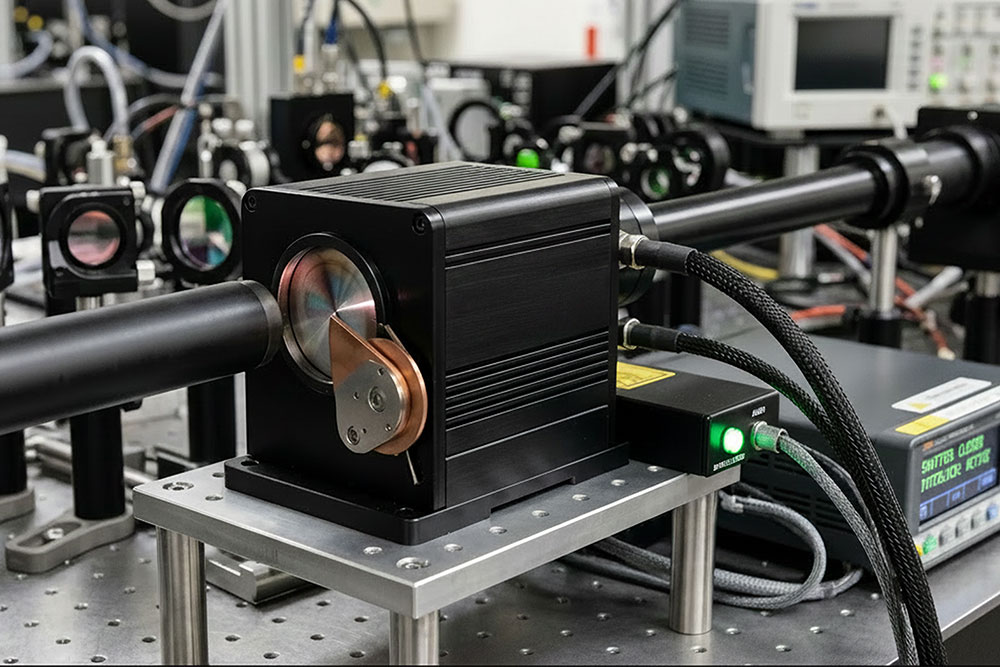
Engineers and system designers working with laser-based equipment quickly learn that wavelength isn’t just a spec on a datasheet. It determines how a laser interacts with materials, what it can and can’t process, and what kind of beam control the surrounding system needs.
YAG laser wavelength sits at the center of many of these decisions. Understanding it properly makes a meaningful difference in how systems are designed and operated.
What Does YAG Laser Stand for?
YAG stands for yttrium aluminum garnet, a synthetic crystal that serves as the host material for the laser’s active medium. In most professional applications, the crystal is doped with neodymium, which is why it is called Nd:YAG.
The neodymium ions embedded in the crystal absorb pump energy and release it as coherent light. The YAG crystal itself offers favorable thermal properties, making it well-suited to high-power and pulsed operation.
This solid-state architecture is a major reason Nd:YAG systems have remained relevant across medical, industrial, and scientific applications for decades. The platform is stable, scalable, and capable of operating in both continuous-wave and pulsed modes, depending on the application’s demands.
Understanding YAG Laser Wavelength at 1064 nm
The primary emission wavelength of an Nd:YAG laser is 1064 nm, sitting in the near-infrared portion of the electromagnetic spectrum. This wavelength is invisible to the human eye, which has real implications for how these systems are safely operated.
At 1064 nm, the beam is poorly absorbed by water but interacts strongly with pigments, metals, and certain biological structures. In industrial settings, this translates to effective interaction with metallic targets. In scientific and medical applications, it allows the beam to pass through tissue or glass and interact with specific subsurface targets.
Additional transitions are possible at wavelengths near 946, 1120, 1320, and 1440 nm, giving the platform some flexibility for specialized applications.
The invisibility of the primary beam is worth pausing on. Unlike a visible laser, where the eye can perceive the beam path, 1064 nm gives no visual warning. There’s no glow, no visible spot unless the beam strikes a fluorescent surface. This is one of the reasons beam control components in Nd:YAG systems carry so much responsibility. A shutter that fails to close is a direct safety risk, more acute than with many other laser types.
Harmonic Wavelengths: Extending the Platform
One of the most useful characteristics of the Nd:YAG platform is its ability to generate shorter wavelengths via frequency conversion. Starting from 1064 nm, the beam can be passed through nonlinear crystals to produce harmonics at progressively shorter wavelengths.
Here’s how those harmonic outputs are used across professional applications:
- 532 nm (second harmonic, green visible): Used in particle image velocimetry, rangefinding, ophthalmology, and certain spectroscopy techniques. The visible wavelength makes it easier to align and observe in lab settings.
- 355 nm (third harmonic, ultraviolet): Common in semiconductor inspection, micromachining, and photolithography. The shorter wavelength allows finer feature resolution than infrared or visible outputs.
- 266 nm (fourth harmonic, deep ultraviolet): Used in analytical instrumentation, materials research, and high-precision microfabrication. Generated by two sequential frequency-doubling stages from 1064 nm to 532 nm, and then again to 266 nm.
The ability to access multiple wavelengths from a single laser platform is one of the reasons Nd:YAG systems appear across such a wide range of capital equipment. A research instrument might operate at 1064 nm for one set of measurements and switch to 355 nm for another.
At NM Laser Products, our laser shutters and optical beam shutters handle these different operating modes, accounting for the power levels and optical characteristics specific to the wavelength in use.
Can a YAG Laser Be Done Twice?
In the context of frequency conversion, the answer is yes. Frequency doubling, or second-harmonic generation, converts the 1064 nm output to 532 nm. A second pass through another nonlinear crystal can then double 532 nm to 266 nm. So in a sense, the process can be applied sequentially to reach deeper into the UV spectrum.
In a different context, this question arises in medical and research settings, where the same YAG laser platform is used for multiple sequential procedures or measurement passes. The platform’s stability in both pulsed and continuous-wave modes enables repeated operation. The key variable is always beam quality and power management across passes.
Wavelength Shapes Every Design Decision
Once you understand how the YAG laser wavelength behaves at 1064 nm and across its harmonics, the downstream engineering decisions start to make a lot more sense. The wavelength determines how the beam interacts with materials, which safety controls are required, and which beam control components are needed.
Medical equipment, semiconductor capital equipment, and scientific instrumentation all come with tight tolerances and no room for component uncertainty.
If your application involves a YAG-based system and you have questions about beam control requirements, reach out to our team at NM Laser Products.
Related Blogs
Why You Should Consider An LCD Optical Shutter
Quick Summary Liquid crystal shutters block and transmit light thr...
Read more
Why Choose A CO2 Laser Shutter Manufacturer For Your Business Needs
Quick Summary Selecting a manufacturer for CO2 laser shutter compo...
Read more
Why Adjusting The Diagonal On Your CO2 Laser Machine Matters
Quick Summary How well a CO2 laser machine's beam tracks acro...
Read more