Large Aperture Laser Shutters: 5 Best Applications
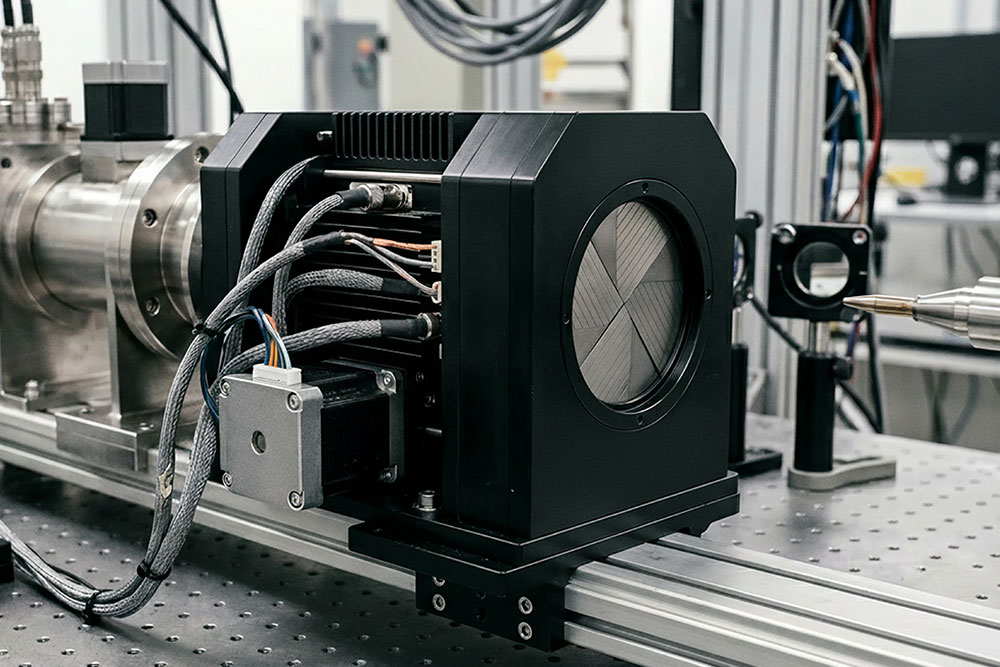
When a laser system grows in complexity, so do its components. The physical requirements on every piece of hardware in the optical path become more exacting. One component that often gets overlooked until it becomes a problem is the shutter.
Large-aperture laser shutters are designed to handle beam diameters that standard shutters simply cannot accommodate. At NM Laser Products, we have spent over 35 years engineering shutters. In this article, we will look at five of the most common and important applications.
What Is a Large Aperture Laser Shutter?
Before getting into applications, it helps to understand what distinguishes a large-aperture shutter from a standard one and why it matters in practice.
To define the aperture of a laser beam in simple terms: the aperture refers to the opening through which the laser beam passes. In a shutter, this opening must be large enough to accommodate the full beam diameter without clipping the edges. Clipping a high-power beam causes problems ranging from optical damage to dangerous stray energy in the system.
The numerical aperture in laser systems describes how widely a beam diverges or converges. It directly influences the beam size at any point along the optical path. As beams travel farther from their source or pass through certain optical elements, they expand. A shutter placed downstream in the system needs an aperture that matches the beam at that point, not at its origin.
Application 1: High-Power Industrial Laser Processing
Industrial laser systems used for cutting, welding, and material processing operate at power levels that require robust beam management. When the laser is not actively processing a part, the beam still needs to go somewhere, and directing it safely is where a shutter comes in.
In these systems, the shutter blocks the beam during:
- Tool changes or workpiece repositioning
- Interlock events triggered by access doors or safety circuits
- Idle states when the laser remains on, but processing is paused
Because industrial lasers often operate at high power with expanded beams, the aperture requirement increases accordingly. A shutter that cannot accommodate the full beam diameter will clip the edges, causing thermal damage over time. Large aperture designs handle the geometry of these systems without compromise.
Application 2: High-Energy Pulsed Laser Systems
Pulsed laser systems present a different kind of challenge. Peak energy per pulse can be extremely high even when average power seems manageable. Nd:YAG systems and similar high-energy platforms are a good example, operating at wavelengths and pulse energies that push the limits of standard optical components.
Large aperture shutters in these systems serve two primary roles. The first is pulse gating, in which the shutter opens and closes to select specific pulses or pulse groups for delivery. The second is safety interlocking, where the shutter closes immediately if any fault condition is detected.
In both cases, the laser damage threshold of the shutter optics matters as much as the aperture size. Our shutters are rated to withstand high laser-induced damage thresholds, making them a good fit for pulsed systems where energy density is high.
Application 3: Medical Laser Equipment
Medical therapeutic laser equipment has some of the most stringent reliability requirements of any application area. A shutter in a medical laser system must open and close hundreds of thousands of times over the life of the equipment without degrading performance.
Large-aperture designs are necessary in medical systems when the beam has been expanded for delivery. Certain therapeutic applications require the beam to cover a broader treatment area. It arrives at the shutter position with a larger diameter than at the source.
Fail-safe operation is non-negotiable here. Our shutters are designed to close on power loss, with no reliance on gravity. In a medical setting, a shutter that fails open is not acceptable under any circumstance. The engineering behind these components reflects that.
Application 4: Semiconductor Capital Equipment
Semiconductor manufacturing equipment runs continuously in production environments and operates at power levels and beam sizes that vary widely by process. Beam control in these systems is precise and exacting, with shutters used for both process control and safety interlocking throughout the optical path.
Large-aperture shutters are used in semiconductor systems, where laser and optical beam shutters are integrated into capital equipment designed to run for years with minimal downtime. Reliability over billions of cycles is the relevant metric, not just initial performance. These are systems where the cost of unplanned maintenance is high, and the shutter needs to perform without becoming a maintenance item.
Application 5: OEM Laser Systems and Laboratory Research
OEM integrators and research laboratories often work with different laser configurations. A system designed for one application may be adapted for another. What worked at the prototype stage may not be adequate at full production scale.
Large aperture shutters give system designers flexibility. When a beam has expanded to the point where a standard shutter poses a clipping risk, upgrading to a larger-aperture model resolves the problem without requiring a complete optical redesign. Customization is also available for OEM applications where the standard product footprint or interface needs to be modified to fit a specific system architecture.
Research environments present similar needs. High-energy experiments, spectroscopy setups, and advanced imaging systems all create situations where the beam at the shutter position is larger than a compact shutter can accommodate.
Choosing the Right Shutter Starts with the Beam
The five applications above share a common thread. In all of them, the beam diameter at the shutter position is the starting point for selecting the appropriate component. Get that wrong and everything downstream suffers.
Understanding the numerical aperture of your laser system, where the beam expands along the optical path, and what power levels the shutter needs to handle are the foundational questions. From there, the selection process becomes straightforward.
We have worked with engineers and OEM integrators across these application areas for decades. If a current system is pushing the limits of a standard shutter, or a new design calls for beam control at larger diameters, we are ready to work through the specifics.
Contact NM Laser Products to discuss your application and find the right fit for your system.
Related Blogs
The Truth About Laser Beam Security Systems
Quick Summary Laser beam security systems are widely misunderstood...
Read more
Insights On Laser Shutter Controllers: What To Know
Quick Summary A laser shutter controller does more than simply ope...
Read more
How Lasers Are Classified In Modern Technology
Quick Summary Laser classification is the foundation of laser safe...
Read more