Microsecond Optical Shutters: A Game Changer For Time-Resolved Spectroscopy
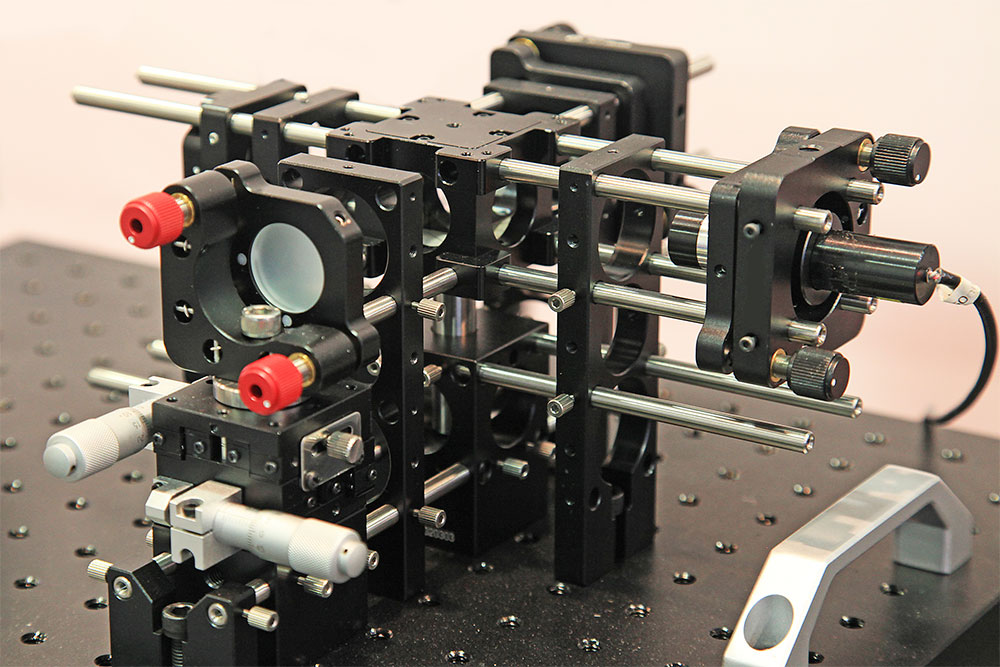
Time-resolved spectroscopy is built on one fundamental requirement: knowing exactly when light interacts with a sample and for how long. Miss that window, and the data becomes unreliable. Get the timing wrong by even a fraction of a millisecond, and the transient event you’re trying to capture has already passed.
A microsecond optical shutter addresses this directly. It gives researchers and system engineers the control they need to study processes that happen faster than most instruments can naturally track.
At NM Laser Products, we’ve spent over 35 years building shutters for optical systems where timing isn’t a preference but a hard technical requirement. Time-resolved spectroscopy is one of the most demanding environments these components encounter.
What a Microsecond Optical Shutter Does in Spectroscopy Systems
Most standard fiber-coupled spectrometers operate with a minimum exposure time measured in milliseconds. At those speeds, any event happening in the nanosecond-to-microsecond range simply doesn’t register as a distinct measurement. It gets averaged out, buried in noise, or missed entirely.
A high-speed optical shutter solves this by acting as a precise gate between the light source and the detector. It opens for a defined, controlled window of time and captures exactly what’s happening in that window. Then, it closes before unwanted background light or stray energy contaminates the signal.
Opening and closing a shutter reliably in microseconds across billions of cycles, without timing drift or mechanical failure, takes serious engineering. This is where component quality becomes the difference between a functional spectroscopy setup and a frustrating one.
How Time-Resolved Spectroscopy Works
The underlying framework in most time-resolved spectroscopy setups is the pump-probe method. A pulsed laser excites the sample, triggering a reaction or state change. A second light source then probes the sample at controlled time intervals after the initial pulse. Spectra are recorded at each interval, building a picture of how the system evolves over time.
Laser flash photolysis is one of the most established techniques within this framework. A nanosecond pulsed laser initiates the event in the sample. A polychromatic probe beam then interrogates the sample, and the transmitted light is separated spectrographically and measured as a function of time. This approach is ideal for studying short-lived intermediates, reaction kinetics, triplet state lifetimes, and light-triggered biological processes.
The time range covered is broad. Slow processes on the millisecond scale can be tracked with conventional spectrophotometric equipment. Phenomena in the nanosecond-to-microsecond range require laser flash photolysis with fast-gating hardware. Processes faster than that require ultrafast femtosecond pump-probe setups.
The microsecond range is a particularly active territory. Chemical intermediates, electron transfer events in proteins, semiconductor carrier recombination, and radical decay in atmospheric chemistry all fall within this window.
Where Shutter Performance Becomes the Limiting Factor
Here’s what makes shutter selection genuinely consequential in these systems. The laser pulse timing is only half the equation. The shutter has to open and close in precise synchronization with the pulse cycle, and it has to do so repeatedly without variation.
A shutter that takes 10 milliseconds to open is useless in a microsecond experiment. A shutter that opens at the right speed but introduces timing jitter degrades signal quality in a different way. A shutter that works perfectly for a thousand cycles and then begins to drift mechanically introduces errors that are hard to diagnose and harder to correct.
Our laser shutters and optical beam shutters are engineered with this in mind. Lifetimes measured in billions of cycles are not marketing language. In a high-repetition-rate spectroscopy system, component longevity is directly tied to the consistency of experimental results over time.
The key performance characteristics that matter in time-resolved spectroscopy setups include:
- Switching speed: Response times in milliseconds down to hundreds of microseconds, matched to the timescale of the experiment
- Synchronization: Clean coordination with pulsed laser sources and detector trigger signals
- Repeatability: Consistent open and close behavior across extended operation without timing drift
- Beam integrity: Minimal optical distortion when open, complete, and clean, blocking when closed
- Position feedback: Real-time confirmation of shutter state to catch any failure before it corrupts data
Signal-to-noise ratio is also directly affected by shutter behavior. Stray light and background exposure during unintended windows introduce noise that obscures the transient signals researchers are trying to capture. A fast, clean-closing shutter removes that variable from the equation.
Fields Where This Level of Timing Control Matters
Microsecond beam gating appears across a wide range of research and instrumentation environments. In photochemistry and photobiology, it reveals electron transfer kinetics and reaction intermediates that steady-state spectroscopy can’t detect.
In materials science, it characterizes how semiconductors and thin films behave after optical excitation. In atmospheric research, flash photolysis experiments use microsecond timing to track OH radical decay and gas-phase reaction rates.
In biomedical research, protein folding kinetics and light-triggered biological processes unfold on timescales where microsecond gating is the only way to observe them.
Precision Timing Deserves Reliable Components
Getting time-resolved spectroscopy right comes down to the components in the beam path. A weak link at any point produces results that can’t be trusted.
We’ve built shutters for research labs, medical systems, and semiconductor capital equipment where these standards are non-negotiable. Reach out to our team if your application involves time-resolved measurements and you want to discuss the beam control requirements for your setup.
Related Blogs
The Truth About Laser Beam Security Systems
Quick Summary Laser beam security systems are widely misunderstood...
Read more
Insights On Laser Shutter Controllers: What To Know
Quick Summary A laser shutter controller does more than simply ope...
Read more
How Lasers Are Classified In Modern Technology
Quick Summary Laser classification is the foundation of laser safe...
Read more