Automated X-Ray Shutters: Benefits And Industry Applications
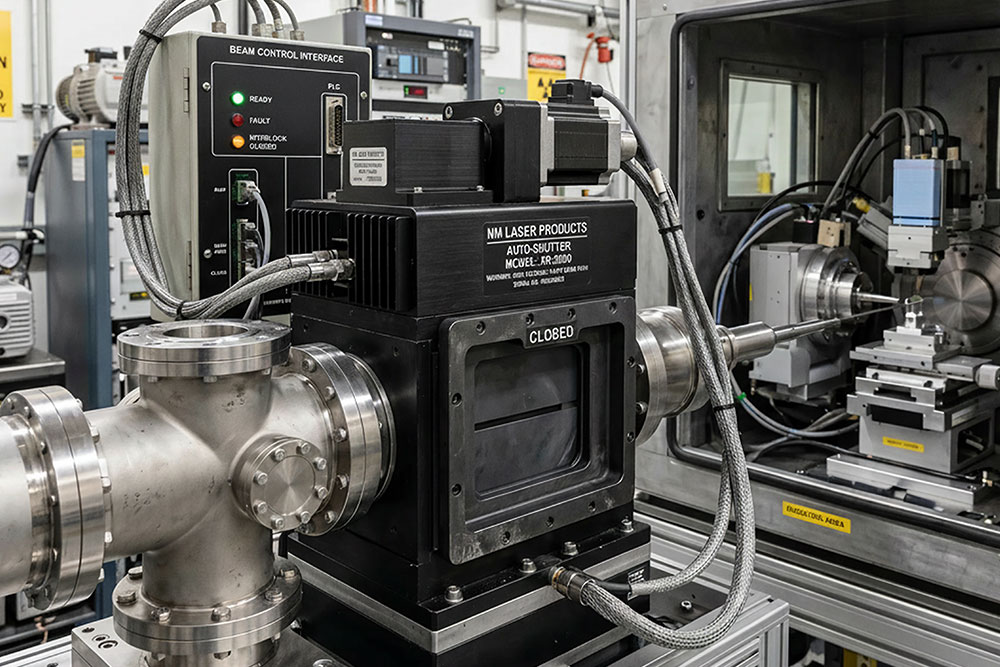
X-ray systems are only as reliable as the components that control them. An automated X-ray shutter sits at a key point in the beam path, deciding when energy reaches its target and when it does not. Get that timing wrong, and the consequences ripple across the entire system, from degraded image quality to damaged components.
At NM Laser Products, we have spent decades manufacturing shutters for high-stakes environments like these. The move toward automation in beam control is a practical response to the precision demands of modern X-ray systems. Knowing why matters whether you are designing a new system or evaluating components for an existing one.
What an Automated X-Ray Shutter Does
A shutter in an X-ray system acts as a barrier between the beam source and the optical path. It opens at precise intervals to allow energy through and closes to block it. In a manual setup, an operator controls this. In an automated setup, the shutter integrates directly with the system’s control electronics, removing the human variable from the timing equation entirely.
Fail-safe design is central to how these shutters operate. A properly designed automated shutter closes on power loss, does not rely on gravity to do so, and responds to interlock conditions without requiring any manual input. The shutter should also maintain consistent motion across thousands of cycles. Any irregularity in opening or closing introduces variability into the process.
The Core Benefits of Automated Beam Control
Automation changes what a shutter can do for a system. Here is where the practical advantages show up most clearly:
- Exposure precision: The shutter opens and closes at exactly the right moment, preventing overexposure and protecting both materials and downstream optics. Irregular exposure creates measurement errors and imaging inconsistencies that manual systems struggle to avoid at speed.
- Fail-safe operation: Automated shutters close when triggered by an interlock event, a power loss, or a fault condition. The system does not depend on an operator to recognize the issue and respond.
- Repeatability across cycles: A well-engineered automated shutter holds its timing across thousands of openings and closings. Drift in timing or mechanical inconsistency leads to process variation, which matters enormously in inspection and diagnostic applications.
- Operator safety: Blocking high-energy beams between exposures protects operators from accidental radiation exposure. Predictable shutter motion removes the uncertainty from beam management.
- System integration: Automated shutters synchronize with control electronics so each pulse reaches the target at the intended moment. In multi-wavelength setups, this coordination enables laser and optical beam shutters of different types to operate together in the same optical workspace.
Semiconductor Inspection and Capital Equipment
Semiconductor manufacturing runs on precision. X-ray metrology is used throughout the production process for wafer inspection, advanced packaging analysis, quality control, and failure analysis. The beam must be gated accurately when parts are repositioned or staged, and any stray exposure can compromise measurement integrity.
Automated shutters in semiconductor capital equipment handle this without interrupting production flow. The shutter closes during repositioning steps and opens when the part is locked in place and ready for inspection. Over the life of a production system, the repeatability of that motion directly impacts output quality.
This is also an environment where long component life matters. Semiconductor production lines do not tolerate frequent maintenance interruptions. Degraded timing or mechanical performance in shutters creates problems that are difficult to diagnose and costly to address.
Medical Imaging and Diagnostic Equipment
In medical diagnostic systems, dose control is not optional. Procedures that require multiple exposures, such as certain imaging scans, depend on the shutter to deliver consistent, controlled doses across each cycle. Automated systems handle this without relying on operator-manual timing.
Beam shutters in medical equipment also serve as a protective function for the equipment itself. Sensitive detectors and optical components downstream from the shutter benefit from precise exposure control. Stray or irregular beam delivery degrades both equipment and output quality over time.
The design requirements here mirror what we apply across our other shutter families: fail-safe closure, predictable actuation, and a lifespan measured in millions of cycles rather than thousands.
Industrial Non-Destructive Testing
Non-destructive testing in aerospace, automotive, and electronics manufacturing uses X-ray systems to inspect internal structures without damaging the components being tested. Shutters gate the beam during part movement and hold it closed during loading and unloading sequences.
Automated operation in NDT environments improves throughput. Inspection cycles run faster when the shutter responds to the control system directly rather than waiting for manual input. It also reduces the risk of exposure events during part changeover, a safety consideration in high-volume production environments.
Scientific Research and X-Ray Crystallography
Research environments present some of the most demanding timing requirements for any shutter. Synchrotron facilities deliver extremely high-brilliance X-ray beams to experimental end stations. Crystallography setups require precise, repeatable gating to isolate specific diffraction events without overexposing the sample.
An X-ray laser diode used in these environments may work in coordination with shutter systems to align, calibrate, or reference beam position before full-power experiments begin. The shutter has to operate with the kind of timing accuracy that allows researchers to isolate specific moments in an exposure sequence.
Custom configurations are often necessary in research settings. Standard shutter footprints do not always fit legacy equipment or highly specialized optical setups. Custom aperture dimensions, stroke lengths, and mounting configurations allow the shutter to integrate without requiring redesign of the broader optical path.
Getting Beam Control Right for Your Application
Automated beam control in X-ray systems is a precision engineering problem. The shutter has to respond consistently, close reliably under fault conditions, and maintain its timing throughout an operational life that typically spans millions of cycles. Choosing the wrong component or underspecifying requirements creates problems that emerge slowly and are hard to trace back to their source.
At NM Laser Products, we have been engineering shutter solutions for demanding applications since 1987. Our experience covers standard configurations and highly customized designs for OEM and research applications.
Contact us to discuss your X-ray system requirements and find the beam control solution that fits your application.
Related Blogs
Why Choose A CO2 Laser Shutter Manufacturer For Your Business Needs
Quick Summary Selecting a manufacturer for CO2 laser shutter compo...
Read more
Why Adjusting The Diagonal On Your CO2 Laser Machine Matters
Quick Summary How well a CO2 laser machine's beam tracks acro...
Read more
Understanding Polarization-Independent Fast Optical Shutters With High Transmission
Quick Summary Some optical shutter designs depend on the polarizat...
Read more