The Essential Guide To YAG Laser Welding
Quick Summary
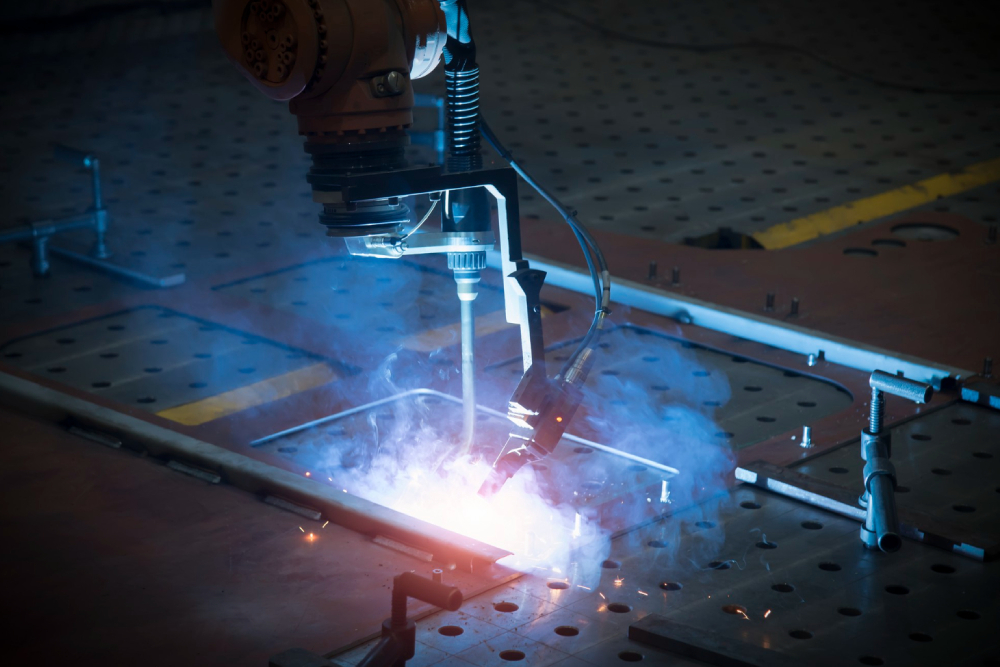
YAG laser welding uses focused pulses of near-infrared light to fuse metal joints with minimal heat spread into surrounding material, which limits distortion and keeps sensitive nearby components intact. A long pulsed Nd YAG laser extends that control to thicker sections, while the standard 1064 Nd YAG laser wavelength gives strong absorption across most common metals used in manufacturing.
Welding a small metal joint next to a sensitive electronic component or a delicate medical assembly leaves little room for excess heat. YAG laser welding solves that problem by concentrating energy into a tight spot and a short pulse, fusing the joint before heat has a chance to spread into the surrounding part.
Getting that level of control depends on shutters rated for YAG wavelengths that gate each pulse with the same precision the weld itself requires.
How YAG Laser Welding Works
A YAG laser welder directs a beam of near-infrared light onto the joint, where the metal absorbs the energy and melts locally to form a fusion bond as it cools. Because the beam can be focused to a small spot and pulsed for a set duration, the heat stays confined to the weld area instead of spreading through the rest of the part.
This makes the process well suited to thin materials, dissimilar metal combinations, and joints located close to heat-sensitive components, where a wider heat-affected zone from arc or resistance welding would cause damage.
The Role of a Long Pulsed Nd YAG Laser in Welding
A long pulsed Nd YAG laser extends the pulse duration well beyond what a standard spot welder uses, giving the beam more time to penetrate deeper into thicker sections without raising peak power to a level that would spatter or crack the material. This mode works well for seam welding, thicker gauge metals, and joints that need a wider melt pool for strength.
Manufacturers building equipment around this mode often pair the laser with a shutter built for pulsed energy delivery, since the shutter has to hold up under repeated high-energy exposure without losing timing accuracy over the life of the machine.
Why the 1064 Nd YAG Laser Wavelength Works Well for Metal
The 1064 Nd YAG laser wavelength sits in the near-infrared range, where most common metals absorb energy efficiently compared to longer wavelengths like CO2. This absorption efficiency means less input power is needed to reach melting temperature, which keeps the overall heat load on the part lower even during longer welds.
The wavelength also delivers well through fiber optic cable, which gives equipment builders flexibility in how they route the beam from the laser source to the work area on a production floor.
Equipment That Keeps YAG Laser Welding Consistent
Weld quality depends on more than the laser source alone. The shutter and beam delivery optics need to hold their alignment and timing across thousands of welds without drifting off spec.
Higher power welding setups often call for a large-aperture shutter option that can handle the beam diameter and energy density involved in deeper penetration welds, since a shutter sized for lighter marking work will not hold up under that kind of continuous load.
Common Applications for YAG Laser Welding
YAG laser welding shows up across a wide range of manufacturing programs, including:
- Battery tab and busbar welding for electric vehicle and consumer electronics packs
- Medical device housing and implant component assembly
- Jewelry repair and fine metal joining work
- Orthodontic wire and small hardware assembly
- Aerospace and precision instrument component welding
Each application calls for a different balance of pulse width, spot size, and repetition rate, which is why equipment builders often turn to a custom shutter design rather than a generic off-the-shelf part.
Reliable YAG Shutter Solutions from NM Laser Products
At NM Laser Products, we build the shutters and controllers that keep YAG laser welding systems performing with the same precision on weld one thousand as weld one. Our team has spent over 35 years developing high-power, high-reliability shutter technology, and every unit we manufacture is made in the USA to hold up under demanding production schedules.
If your application calls for a standard YAG model or a fully custom design built around a specific pulse width or power range, we work directly with your engineering team to match the shutter to the job. Our components are built for long service life, often rated for hundreds of millions of cycles, so weld quality stays consistent from the first part of the shift to the last.
Reach out to our team to talk through your YAG laser welding project, or submit your specs through our online RFQ page to get a shutter built around your exact requirements.
FAQs
What makes YAG laser welding different from traditional welding methods?
YAG laser welding concentrates energy into a small, precise spot, which limits heat spread and reduces distortion compared to arc or resistance welding methods.
When should a long pulsed Nd YAG laser be used instead of a standard pulse mode?
Longer pulse durations work best for thicker materials or wider joints, since the extended pulse allows deeper penetration without raising peak power to a damaging level.
Why is the 1064 Nd YAG laser wavelength common in metal welding?
Most metals absorb near-infrared light efficiently at this wavelength, which lowers the power needed to reach melting temperature and supports delivery through fiber optic cable.
Related Blogs
Why You Should Consider An LCD Optical Shutter
Quick Summary Liquid crystal shutters block and transmit light thr...
Read more
Why Choose A CO2 Laser Shutter Manufacturer For Your Business Needs
Quick Summary Selecting a manufacturer for CO2 laser shutter compo...
Read more
Why Adjusting The Diagonal On Your CO2 Laser Machine Matters
Quick Summary How well a CO2 laser machine's beam tracks acro...
Read more