Understanding AOMs And Shutters: Key Information You Need
Quick Summary
Think of the AOM as the sprinter and the mechanical modulation shutter as the bouncer at the door. An acousto-optic modulator gates light in nanoseconds with nothing moving, though a sliver still slips into the zero order, and the crystal gets fussy about heat and power. A blade-type shutter needs milliseconds to move, yet once it’s shut the path goes dark, so rigs that need a truly dark beam between runs usually end up carrying both.
Somewhere in a lab tonight, a photomultiplier tube is counting photons it shouldn’t see. The AOM driver reads zero RF, and still there’s a faint, maddening baseline. The leak usually lives in the beam control, which raises a blunt question: does the job belong to an acousto-optic modulator, a mechanical modulation shutter, or both?
At NM Laser Products, that question lands on our engineers’ desks regularly, and our team in San Jose designs optical shutters for these systems. Here’s the plan: how each device works, where an AOM leaks, what heat does to it, and the pairing that settles the argument.
What A Modulation Shutter Does In A Laser Beam Path
Modulation, stripped of jargon, is timing: when photons reach the target, and how much light arrives. So why modulate a signal at all? Ask anyone pulse picking off a mode-locked oscillator or gating exposure on a wafer inspection stage.
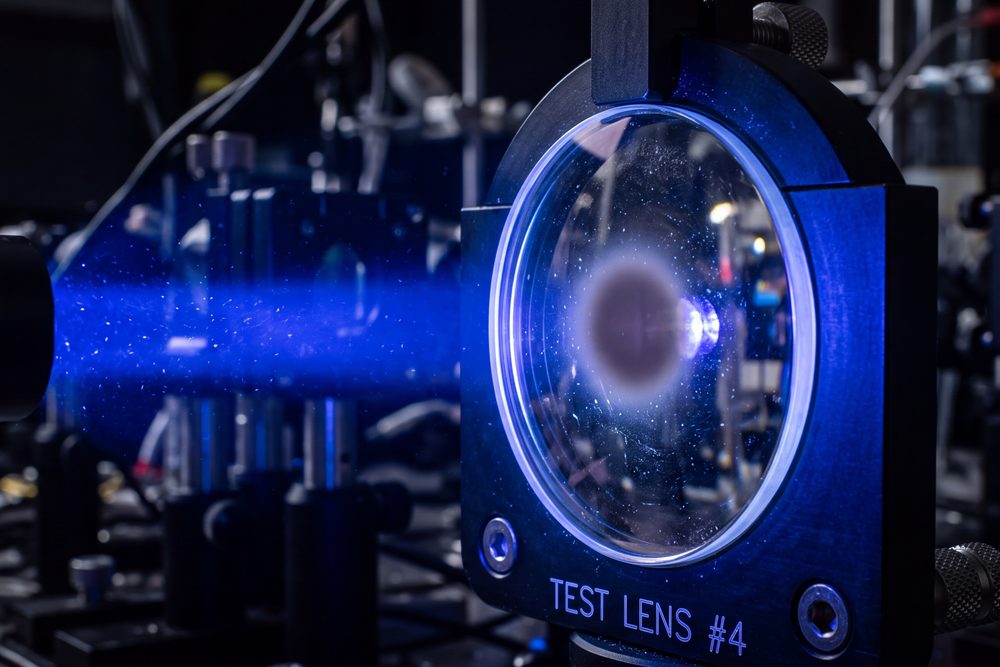
A modulation shutter is blunter: a blade or flexure swings into the beam and stops light dead. Our page on modulation shutter technology walks through the mechanics.
How An Acousto-Optic Modulator Switches A Laser Beam
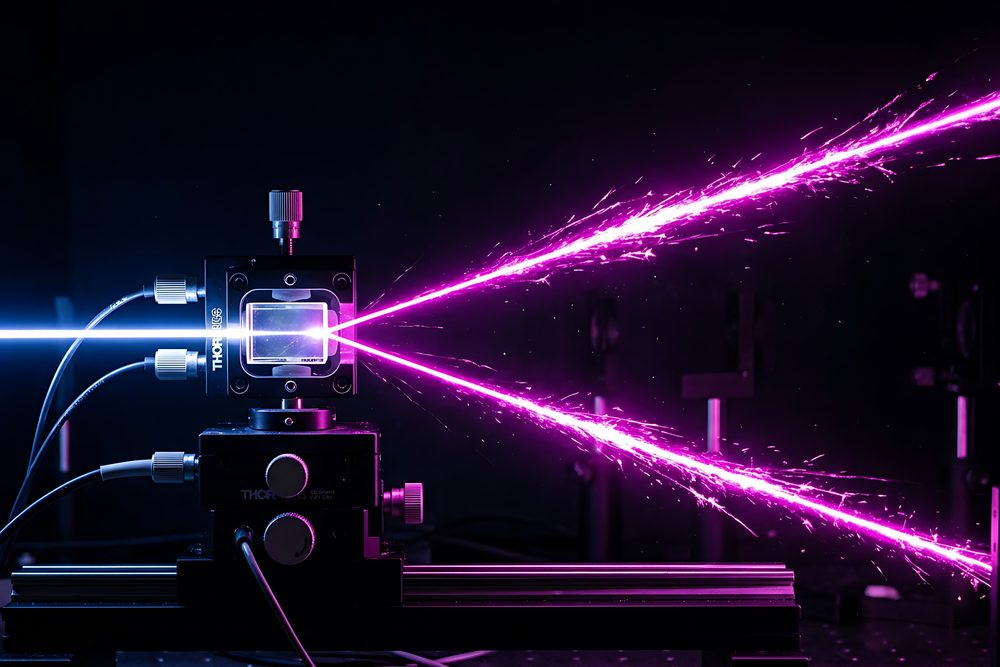
An AOM is a crystal with a speaker glued to it, more or less. An RF signal drives a piezo transducer, and the sound wave it sends through the crystal acts like a moving grating. Light peels off into a first-order beam. Kill the RF, and it carries straight on into the zero order.
Squeeze the beam waist inside the crystal, and the acoustic wavefront crosses it in nanoseconds, with no wear. One quirk matters to interferometry and cold-atom groups: the diffracted beam comes out frequency-offset by the RF drive frequency, which is sometimes the whole point and sometimes a headache.
Zero-Order Leakage And Extinction Limits In AOM Beam Control
Here’s the rub. Diffraction efficiency doesn’t reach a perfect hundred percent, so some light lingers in the zero order even at full RF. Use the zero order as your output, and it glows faintly when off. The first order gets far darker, though scatter and RF bleed-through can still sneak a trace past.
Does a trace matter? Ask the photoresist. Over hours of idle time, that whisper adds up to real exposure, so read the extinction ratio before you trust an AOM as your off switch.
Power Handling, Heat, And Aperture In AOMs Vs. Mechanical Laser Shutters
Crystals are picky about watts. At high average power, the light they absorb turns into thermal lensing, pointing drift, and sooner or later damage. The RF driver adds heat of its own, and fast switching forces a fat beam through a tiny waist.
A mechanical shutter shrugs off those headaches. Our LST500 handles 100 watts across a 15 mm aperture with no crystal to heat, and you pay for it in milliseconds. Our breakdown of the differences between laser modulators and shutters lays out the long-form comparison.
When To Pair An AOM With A Mechanical Laser Shutter
Pairing makes sense as soon as a system needs fast modulation during a run and a dark beam path between runs. The choreography:
- Open the shutter a few milliseconds ahead of the run.
- Let the AOM do the fast work.
- Drop the shutter once the run ends, so leftover AOM leakage stays off the sample.
Park the shutter upstream and the crystal stops soaking up full power during idle stretches. After that, the fight is usually about space. One customer, Masood, wrote in a 5-star review that his team “got a custom laser shutter that fit our package constraints.”
Choosing Speed, Certainty, Or Both For Your Laser Beam Path
Our rule of thumb: hand the AOM anything that needs speed, and the mechanical shutter anything that needs certainty. NM Laser Products has engineered standard and custom optical shutters in San Jose for more than 35 years, and we’re happy to match one to the AOM in your layout.
Talk with our shutter engineers at NM Laser Products, Inc. about the shutter that completes the beam path.
Frequently Asked Questions
Does an AOM need a dedicated driver?
Yes, it needs an RF driver tuned to its center frequency and rated for its power. Mismatch them and diffraction efficiency quietly drops.
Can a mechanical shutter block any laser wavelength?
Close to any, from UV through YAG to CO2, as long as the blade coating suits the beam. Mention wavelength and power density in your quote request.
How long does a mechanical modulation shutter last?
Lifetime varies by design, and our LST-5VDC is rated for more than one billion cycles. At 50 Hz around the clock, that’s months of nonstop work.
Can an AOM replace a laser safety shutter?
It’s a poor substitute. Driver faults can push light down the path and the off state leaks, so build interlocks around a physical shutter that closes when power drops.
Can one control signal run both the AOM and the shutter?
Yes, one TTL timing source can trigger both, provided the controller allows for the shutter’s travel time. Time it so the blade opens a touch early and closes a touch late.
Related Blogs
Why Investing In An OEM CO2 Laser Beam Shutter Is Essential For Your Business
Quick Summary An OEM CO2 laser beam shutter is specified with the m...
Read more
What You Need To Know About High-Intensity Laser Shutters
Quick Summary A high-intensity laser shutter has to survive the bea...
Read more
USB Optical Shutters Explained: What You Should Know
Quick Summary A USB optical shutter is a beam shutter whose driver ...
Read more