The Role Of Laser And Shutter Technologies In Aerospace Production
Quick Summary
Aerospace manufacturers depend on precise beam control to protect optical systems during cutting, welding, drilling, and inspection. Laser shutters in aerospace engineering guard sensitive components from unplanned exposure, support repeatable results, and extend the service life of optical assemblies used throughout production and testing.
Aerospace production depends on exacting light control, and laser shutters in aerospace engineering give manufacturers a way to guard delicate optics while high-powered beams cut, weld, and inspect components built for flight.
Facilities that build turbine blades, fuselage panels, and satellite housings depend on shutters that respond in milliseconds, since a single unplanned pulse can scar a lens, ruin a workpiece, or throw off a calibration reading.
NM Laser Products designs laser shutters and optical beam shutters built for demanding production floors, where reliability over millions of cycles matters as much as raw power handling.
Precision Cutting and Welding in Airframe Manufacturing
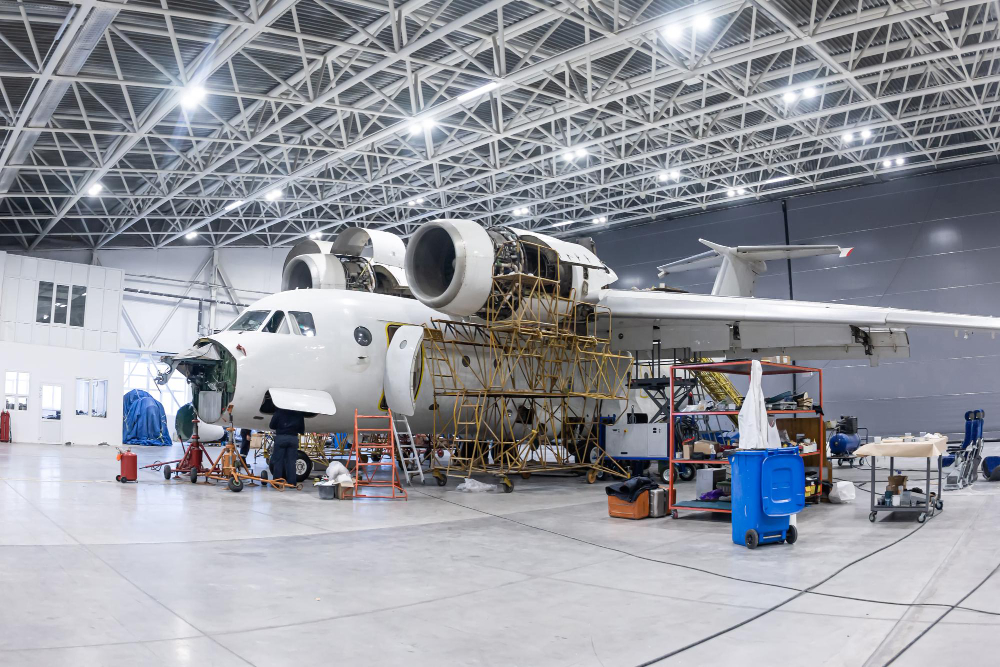
Modern airframes are built from titanium, aluminum alloys, and composite panels that call for precise beam delivery during cutting and welding.
A shutter that closes too slowly lets residual energy scatter across a workpiece, leaving burn marks or warping thin metal skins that later fail inspection.
Fabrication teams working on wing spars, fuselage sections, and engine mounts count on shutters engineered for fast response and consistent operation across long production runs.
Laser shutter technology built for high duty cycles keeps beam paths clean between passes, so operators move from one cut to the next without pausing to recalibrate.
Some aerospace parts require dozens of individual laser passes before a single component clears final inspection, and each pass depends on a shutter that opens and closes with the same timing it had on day one.
Over the life of a production contract, that kind of dependability separates suppliers who meet delivery schedules from those who fall behind on rework.
NM Laser Products manufactures shutters rated for millions of open-close cycles, giving fabrication shops a component built to match the pace of aerospace manufacturing rather than slow it down.
Protecting Optics During Laser Drilling of Turbine Components
Turbine blades and combustor liners need hundreds of tiny cooling holes drilled at exact angles, a process that puts enormous strain on the optics guiding each pulse. Stray reflections from a metal surface can send energy back through the beam path.
Without a fast-acting shutter, that reflected light reaches lenses and mirrors that cost far more to replace than the shutter protecting them.
Drilling cells that run around the clock benefit from shutters built to close automatically the moment a fault is detected, stopping backscatter before it reaches sensitive glass.
This kind of protection matters most on parts headed for jet engines, where a single misdrilled hole can send a blade back to scrap.
Optical shutters positioned correctly within a drilling station act as insurance against the unpredictable behavior of reflective metals, and that insurance pays for itself the first time it stops a damaging pulse.
Turbine manufacturers who build shutter protection into their process from the start spend less time replacing optics and more time running parts through the line.
Testing and Calibration of Avionics and Sensor Systems
Before an aircraft sensor or targeting system reaches a production line, it passes through extensive optical testing. Technicians calibrate lenses, verify laser rangefinders, and check the alignment of guidance optics under conditions that mimic actual flight.
A shutter in this setting works less like a safety device and more like a switch that lets engineers control exposure down to the millisecond, running a component through repeated test cycles without exposing it to unnecessary light between measurements.
Avionics labs that test hundreds of units a month rely on that kind of control to keep results consistent from the first unit tested to the last.
Sensor housings built for satellites and reconnaissance aircraft go through similar testing before launch or delivery, since a flaw discovered on the ground costs far less than one discovered in orbit or mid-flight.
Shutters used in these labs need to hold their timing precisely after thousands of open-close cycles, because a shutter that drifts even slightly can throw off a calibration reading and force a retest.
Building Reliable Optics for Satellite and Spacecraft Components
Spacecraft components spend years in a setting where repair is not an option, so every optical element that goes into a satellite housing or instrument package gets tested under conditions far harsher than typical ground use.
Shutters used during this testing phase have to perform without failure across a punishing schedule of thermal cycling, vacuum exposure, and vibration testing, since a shutter failure during a qualification test can set a launch schedule back by months.
Manufacturers building optical instruments for orbit look for shutters with a proven cycle life and documented performance data, not estimates.
NM Laser Products builds shutters with published specifications for cycle life and damage threshold, giving spacecraft integrators the kind of documentation that satellite programs require before signing off on a component.
Choosing the right shutter early in a satellite build reduces the chance of a costly redesign later, when swapping a component means reworking an entire optical assembly.
Quality Control and Inspection on the Production Floor
Inspection stations use lasers to measure tolerances on finished parts, checking everything from turbine blade curvature to the flatness of a composite panel.
These stations run for entire shifts without downtime, and each measurement depends on a beam that turns on and off exactly when commanded.
A shutter with delayed response introduces measurement error, and on parts machined to tolerances measured in microns, that error shows up as a part failing inspection for no real defect.
Quality teams that catch this early trace the problem back to shutter timing rather than the part itself, but by then production has already lost hours to a false rejection.
Choosing shutters built for consistent, repeatable timing keeps inspection data accurate and keeps good parts moving through the line instead of sitting in a rework queue.
Aerospace suppliers under contract to major manufacturers cannot afford inspection errors that trace back to equipment rather than actual part quality.
Why Aerospace Manufacturers Choose NM Laser Products
At NM Laser Products, we build shutters for the parts of aerospace production where failure is not an option.
Our engineering team has spent over 35 years refining shutter designs for laser and optical systems used in cutting, welding, drilling, testing, and inspection, and that background shapes every shutter we manufacture today.
We build each unit in the United States, and we stand behind the cycle life and damage threshold numbers we publish, because aerospace customers need a supplier they can verify rather than take at their word.
We know that aerospace manufacturers cannot treat a shutter as an afterthought. A shutter sits at the point where a costly beam path meets a costly optical component, and the wrong choice puts both at risk.
NM Laser Products works with production and testing teams to match shutter specifications to the actual demands of their process, whether that means high cycle life for a drilling station or fast response time for a calibration lab.
We have built our reputation on shutters that perform the way our documentation says they will, shift after shift, contract after contract. That reliability is what keeps aerospace suppliers coming back to us for their next production run.
If you have questions about how NM Laser Products can support your aerospace production line, please reach out to our team.
Frequently Asked Questions
How long does it take to get a custom laser shutter built for an aerospace application?
Lead times differ based on the specifications involved, but NM Laser Products works directly with engineering teams early in a project to keep custom builds moving on a schedule that fits aerospace production timelines.
Can laser shutters be added to production equipment already in use?
Most shutters are built to fit standard mounting configurations, so adding one to an existing laser or optical setup typically does not require reworking the surrounding equipment.
What laser wavelengths do NM Laser Products shutters support?
NM Laser Products builds shutters compatible with a wide range of wavelengths used across aerospace applications, from CO2 lasers used in cutting and welding to the shorter wavelengths used in precision drilling and optical testing.
Related Blogs
Why You Should Consider An LCD Optical Shutter
Quick Summary Liquid crystal shutters block and transmit light thr...
Read more
Why Choose A CO2 Laser Shutter Manufacturer For Your Business Needs
Quick Summary Selecting a manufacturer for CO2 laser shutter compo...
Read more
Why Adjusting The Diagonal On Your CO2 Laser Machine Matters
Quick Summary How well a CO2 laser machine's beam tracks acro...
Read more