Exploring The UV Laser Glass Engraving Process
Quick Summary
UV laser glass engraving uses cold ablation to mark glass with exceptional precision and minimal thermal damage. This page covers how the process works, which materials it suits, how it compares to CO2 and fiber lasers, and what industries depend on it most. It also looks at the beam control components that keep engraving output consistent and repeatable across production runs.
Glass has always been one of the more demanding materials to mark precisely. Mechanical engraving risks chipping, CO2 lasers generate heat that causes micro-fractures, and standard fiber lasers struggle to absorb into clear glass at all.
The rise of UV laser for glass engraving has addressed all three of these problems in a single technology, giving manufacturers and engineers a method that delivers clean, detailed marks without compromising the integrity of the glass beneath.
At NM Laser Products, our UV laser shutters are built to support precisely this kind of demanding application, giving beam control systems the reliability and optical performance that high-precision glass marking requires.
How UV Lasers Work on Glass
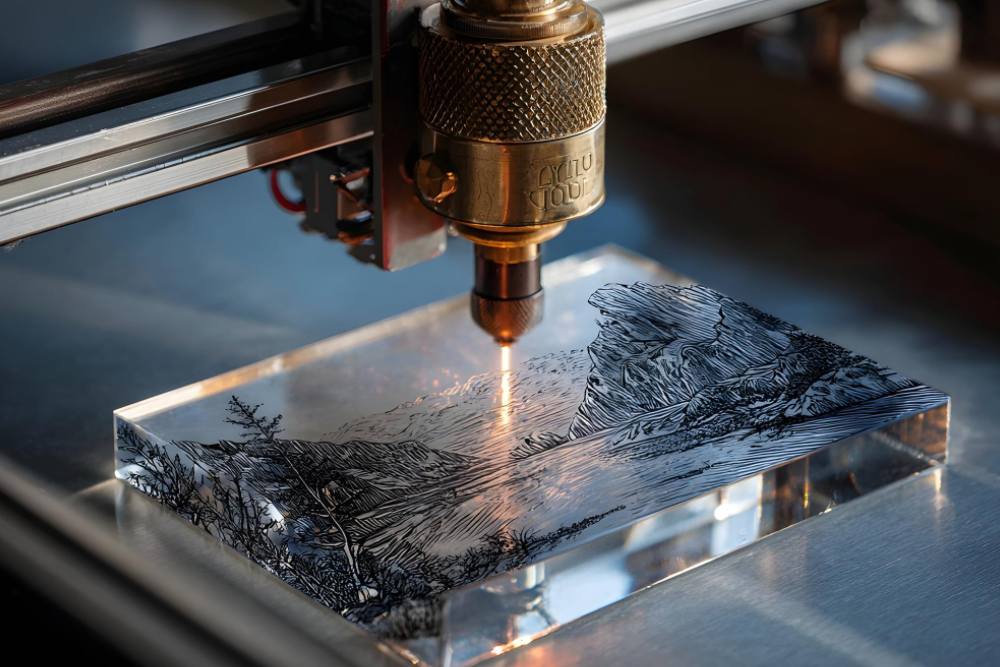
UV lasers operate at a wavelength of approximately 355 nanometers, which sits in the ultraviolet region of the spectrum. At this wavelength, glass absorbs laser energy very efficiently. Rather than generating heat that melts or fractures the surface, the laser breaks molecular bonds directly in a process called cold ablation.
Cold ablation removes material cleanly and precisely, leaving sharp edges and fine detail without the heat-affected zone that thermal laser processes produce. The focused spot size of a UV laser is typically under 20 microns in diameter, which is what makes such fine detail possible. Barcodes, serial numbers, intricate artwork, and microscale markings that would be impossible with other methods can be produced reliably and repeatedly.
Glass Types That Work Well with UV Laser Engravers
UV laser engravers are compatible with most commercially available glass types. Borosilicate glass, used widely in laboratory and scientific equipment, responds very well to UV engraving because of its high UV absorption and thermal resistance.
Soda-lime glass, found in everyday products like windows and bottles, is one of the most commonly engraved substrates. Fused silica, used in precision optical components, is well-suited to UV laser marking because of the minimal thermal distortion involved. Tempered glass used in consumer electronics and crystal glass used in decorative and award products are also regularly processed with UV laser engravers.
Each material requires its own parameter settings. Pulse frequency, scan speed, and laser power all need to be dialed in for the specific glass type and the desired engraving depth. Getting these parameters right is where experience and good process documentation make a real difference to output quality.
The UV Laser Glass Engraving Process Step by Step
Design preparation is the starting point. Artwork or text is prepared as a vector file and translated into a tool path by the laser control software. The level of detail achievable with a UV engraver means that very fine features can be included in the design without concern about the laser being unable to resolve them.
Fixturing comes next. The glass piece is secured on the engraving bed so that it cannot move during the process. Even small vibrations or shifts will affect alignment and degrade the quality of fine detail.
Parameter setting involves the operator configuring laser power, pulse rate, scan speed, and focal depth based on the glass substrate and the job requirements. UV laser systems typically run at lower average power than CO2 or fiber systems because the glass absorbs the UV energy so efficiently.
Engraving then proceeds with the laser head moving across the surface in the programmed pattern. For deeper engravings, multiple passes are used. The optical laser shutter within the laser system controls beam exposure at the start and end of each pass, keeping transitions clean and preventing unintended marking outside the design boundary.
Post-processing involves cleaning the glass surface to remove ablation residue. In some applications, a paint or resin fill is applied to the engraved area to improve contrast, particularly on clear glass where the engraving alone may be subtle.
How UV Compares to CO2 and Fiber Lasers for Glass
CO2 lasers are the most widely used alternative for glass engraving. They operate at around 10,600 nanometers, and while glass does absorb CO2 energy, the process is thermal rather than ablative. This generates heat that can produce micro-fractures around the engraved edges, which is acceptable for some decorative applications but problematic for precision work or optical components where surface integrity matters.
Fiber lasers operate at around 1,064 nanometers. Clear glass is largely transparent at this wavelength, so fiber lasers have very limited effectiveness on standard glass without surface coatings or additives. They are not a practical option for most glass engraving applications.
UV lasers avoid both of these limitations. Their short wavelength is well-absorbed, and cold ablation eliminates the thermal damage issue entirely. For manufacturers working in optical technology where surface quality directly affects product performance, UV laser engraving is frequently the only method that meets specification.
Industries That Use UV Laser Glass Engraving
Electronics manufacturers use UV laser engravers to mark serial numbers, logos, and identification codes on glass display panels and components. Medical and laboratory equipment producers rely on UV engraving for permanent, sterile-safe markings on glass instruments and sample containers.
The optical component industry uses it for marking lenses, filters, and prisms. Decorative and promotional product manufacturers engrave awards, trophies, and branded glassware. Architectural glass producers apply UV engraving to decorative panels and custom signage.
Choosing a UV Laser Engraver: What to Look For
Output wavelength should be 355 nanometers for standard glass engraving applications. Beam quality, expressed as M-squared, should be as close to 1.0 as possible for the finest detail. Pulse energy and repetition rate determine engraving speed and depth control. Work area size needs to accommodate the largest glass pieces in your production mix. Software compatibility with your design file formats keeps the workflow efficient.
Beyond the laser source itself, the beam control components in the system have a direct effect on output quality. A UV laser shutter with the appropriate optics for 355 nanometers controls beam delivery precisely, contributing to clean edges, accurate start and stop points, and consistent results across long production runs.
Precision Components for UV Laser Systems
At NM Laser Products, our UV laser shutters are built for the optical power handling, LIDT ratings, and long service life that production UV engraving demands.
With USA manufacturing, fail-safe design, and over 35 years of engineering experience behind every product, we supply beam control hardware that integrates cleanly into UV laser systems and performs reliably over hundreds of millions of cycles. Contact our team to find the right shutter for your UV laser engraving application.
FAQs
Can UV lasers engrave all types of glass?
UV lasers are compatible with most common glass types including borosilicate, soda-lime, fused silica, tempered, and crystal glass. Parameters need to be adjusted for each material to achieve the best results without causing damage to the substrate.
How deep can a UV laser engrave into glass?
Engraving depth depends on laser power, pulse frequency, number of passes, and glass type. UV laser engravers typically produce shallow surface marks in a single pass, but multiple passes can achieve greater depth for specific applications without significantly increasing thermal damage.
Are there safety requirements specific to UV laser engraving systems?
Yes. UV laser systems require appropriate enclosures, safety interlocks, and protective eyewear rated for the UV wavelength. A reliable UV laser shutter is a standard safety component in these systems, controlling beam access and supporting interlock function to protect operators during and between engraving operations.
Related Blogs
Understanding OD (Optical Density) In Laser Safety Protocols
Quick Summary Optical density ratings determine whether a piece of...
Read more
Understanding Long-Pulsed Nd:YAG Laser Technology
Quick Summary Pulse duration significantly influences how a laser ...
Read more
Nd:YAG Lasers Explained: How They Work And Their Practical Uses
Quick Summary This type of laser combines a neodymium-doped crysta...
Read more