Understanding Long-Pulsed Nd:YAG Laser Technology
Quick Summary
Pulse duration significantly influences how a laser interacts with its target. Millisecond-scale pulses from long-pulsed systems create a gentler, more gradual heating effect than the nanosecond bursts associated with Q-switched operation.
That difference influences which applications are better suited to long-pulsed technology than to faster alternatives with higher peak power.
A long pulse Nd:YAG laser distributes its energy over a period measured in milliseconds rather than nanoseconds, creating a different thermal profile from short-pulsed or Q-switched systems built around the same underlying platform.
Among the various types of lasers built around the yttrium aluminum neodymium-doped garnet crystal, long-pulsed configurations occupy a distinct niche defined by pulse width rather than wavelength alone, since the core 1064 nanometer output remains consistent across pulse modes.
What Sets Long-Pulsed Operation Apart
Standard Nd:YAG Q-switched systems compress energy into extremely short, high-peak-power pulses that last nanoseconds. This makes them well suited to applications requiring a rapid, concentrated release of energy.
Long-pulsed configurations follow a different approach. They extend the pulse duration into the millisecond range while maintaining lower peak power relative to the total energy delivered during each pulse.
This extended pulse width gives heat generated at the target more time to spread into surrounding structures. The result differs from the abrupt, localized thermal effect typically associated with shorter pulses.
In practical applications, this creates a treatment profile that works well for larger or deeper targets that benefit from sustained thermal exposure rather than an instantaneous energy spike.
The Physics Behind Extended Pulse Duration
Achieving a longer pulse width requires cavity design and control electronics that differ from those used in a standard Q-switched configuration.
Instead of relying on a rapid switch to release stored energy all at once, long-pulsed systems can modulate the pump source or use specialized cavity-dumping techniques to sustain laser output over an extended period.
This engineering difference affects component selection throughout the system. It influences everything from the pump source itself to the cooling architecture required to manage heat generated during longer pulse cycles.
Thermal relaxation time, which describes the period required for a target to dissipate absorbed heat, plays a direct role in determining why pulse duration matters.
Matching the pulse width to the target’s thermal relaxation time can concentrate energy on the intended structure while limiting unwanted heating in adjacent tissue or material. This principle applies to selective photothermolysis in medical applications as well as precision heating control in industrial settings.
Applications That Favor Long-Pulsed Systems
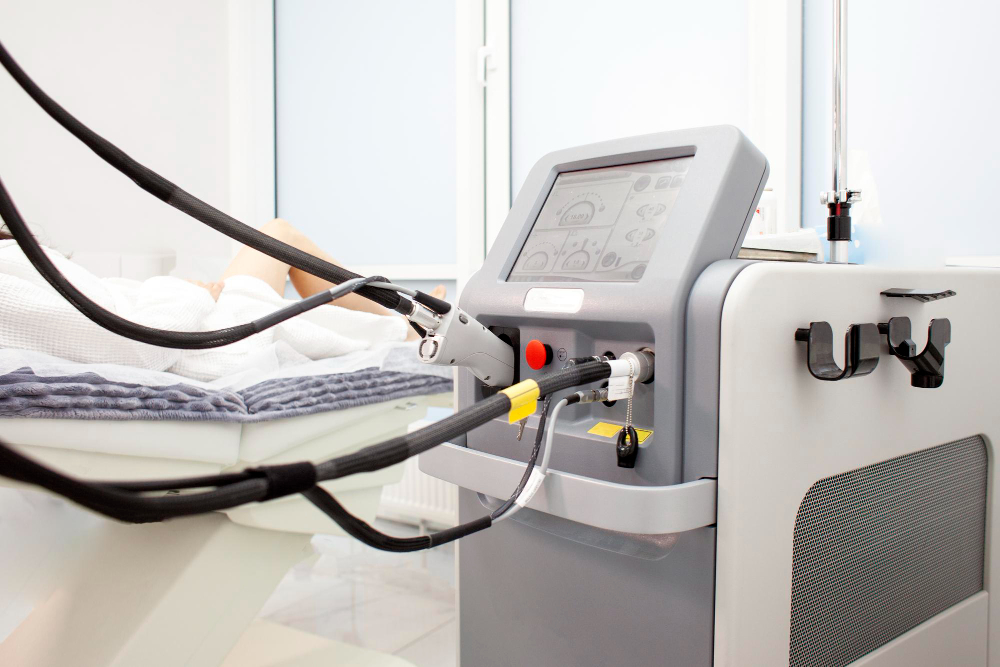
Long-pulsed lasers are widely used in medical and cosmetic applications that target larger or deeper structures. Examples include certain vascular lesions and hair removal procedures, where a gradual heating profile can reduce the potential for damage to surrounding skin.
The extended pulse gives energy more time to reach deeper follicles or vascular structures without creating the abrupt, concentrated surface effect associated with a nanosecond pulse.
Industrial applications rely on similar thermal principles.
Processes that require controlled, sustained heating instead of an instantaneous energy spike can benefit from the long-pulsed approach.
This is particularly relevant to specialized laser welding applications, where gradual heat buildup can improve weld quality for certain material combinations compared with rapid, high-peak-power pulses.
Comparing Long-Pulsed to Other Nd:YAG Modes
Facilities working with Nd:YAG technology often choose among continuous-wave, Q-switched, and long-pulsed configurations based on the specific outcome required. Continuous-wave operation is suited to applications that demand sustained and consistent energy delivery.
Q-switched operation produces extremely short, high-peak-power pulses that work well for precision applications involving small, well-defined targets.
Long-pulsed operation falls between these two approaches. It trades some peak power for a controlled, extended exposure window that can be well suited to larger targets or applications where excessive collateral heating is a concern.
Selecting the appropriate mode for a particular application depends on factors such as target size, target depth, and the thermal relaxation characteristics of the material or tissue involved. Using the wrong pulse mode can lead to poor results even when the wavelength and average power appear to match the application requirements on paper.
Safety Requirements Specific to Long-Pulsed Systems
The extended exposure duration characteristic of long-pulsed operation changes the safety calculation compared to shorter-pulsed systems.
Maximum Permissible Exposure values shift with pulse duration, meaning a long-pulsed system may require different optical density ratings on protective equipment than a Q-switched system operating at the same average power and wavelength.
Properly specified YAG laser shutters account for this distinction, verified against the actual pulse characteristics of the system in use rather than a generic 1064 nanometer rating that assumes a different pulse structure.
A shutter rated for a Q-switched system’s brief, high-peak-power pulses may not provide equival protection against the sustained exposure profile of a long-pulsed configuration, since the underlying exposure hazard differs even at similar average power levels.
Why Matching Equipment to Pulse Mode Matters
Long-pulsed Nd:YAG technology addresses applications that neither continuous-wave nor Q-switched configurations handle as effectively. That advantage depends on having safety infrastructure that matches the system’s specific pulse characteristics.
A facility that treats all Nd:YAG types as interchangeable when selecting shutters or protective barriers risks creating a mismatch between documented protection and the actual exposure hazard.
We have manufactured shutters and optical components for Nd:YAG systems across every pulse mode for more than 35 years. Our team verifies performance against the specific pulse width, peak power, and wavelength of the equipment each customer operates.
Every product manufactured at NM Laser Products comes with documentation tied to the exact configuration it protects. Products are made in the USA and backed by decades of direct experience working alongside engineers who depend on getting these details right the first time.
That depth of experience distinguishes a generic safety component from one designed to match the laser it operates alongside.
Our team is ready to help with any questions about NM Laser Products. Contact us today.
Frequently Asked Questions
Is a long-pulsed Nd:YAG laser the same as a millisecond laser?
The terms describe the same general concept. Long-pulsed and millisecond both refer to pulse durations extended well beyond the nanosecond range typical of Q-switched systems, though exact terminology can differ by manufacturer or application.
Can a single Nd:YAG system switch between long-pulsed and Q-switched operation?
Some systems offer this flexibility through adjustable control electronics, while others are built specifically for one pulse mode. Facilities needing both capabilities should confirm this before purchase rather than assuming a system supports multiple modes.
Does long-pulsed operation reduce the overall power output of an Nd:YAG laser?
Not necessarily. Long-pulsed systems can deliver substantial total energy per pulse; the difference lies in how that energy is distributed over time rather than a reduction in total output capability.
Related Blogs
Understanding OD (Optical Density) In Laser Safety Protocols
Quick Summary Optical density ratings determine whether a piece of...
Read more
Nd:YAG Lasers Explained: How They Work And Their Practical Uses
Quick Summary This type of laser combines a neodymium-doped crysta...
Read more
MOPA Vs. UV Laser: Which One Is Right For Your Needs?
Quick Summary Choosing between these two technologies depends on t...
Read more