How Lasers Are Classified In Modern Technology
Quick Summary
Laser classification is the foundation of laser safety engineering, providing a consistent framework for communicating hazard levels across products, industries, and regulatory environments. This page covers the full class of lasers defined under IEC 60825-1 and ANSI Z136.1, explains what each class means in practical terms, and addresses the common question of whether a class 5 laser exists. It is aimed at engineers, safety professionals, and anyone specifying or working with laser equipment.
Lasers are used in applications ranging from supermarket barcode scanners to industrial metal cutting systems, and the difference in hazard between these two extremes is enormous. Managing that range of hazard levels in a way that is consistent, internationally recognized, and practically useful is exactly what the laser classification system was designed to do.
Understanding how lasers are classified gives engineers, safety officers, and product developers a common language for discussing laser hazards and the controls needed to manage them.
At NM Laser Products, we design and manufacture laser shutters and optical shutters across the full range of laser classes, giving system designers the beam control and safety interlock components their application demands.
The Standards Behind Laser Classification
Laser classification is governed by two primary standards. IEC 60825-1 is the international standard used across most of the world, and ANSI Z136.1 is the primary standard used in the United States. Both use a similar class structure, though there are some differences in terminology and AEL values between versions and between the two standards.
The classification is based on the maximum accessible emission, which is the power or energy that a person could realistically be exposed to from the product under foreseeable use conditions. Classification reflects the worst-case exposure scenario during normal use, and it applies to the product as a whole rather than just the laser source inside it.
The Full Class of Lasers Explained
Class 1
Class 1 is the lowest hazard category. Products in this class are safe under all conditions of normal use, with accessible emission below the injury threshold for both eye and skin. Many class 1 products contain higher-power internal lasers within enclosed housings. Laser printers and optical disc drives are familiar examples.
Class 1M
Class 1M products are safe for unaided viewing but may be hazardous if viewed through magnifying optical instruments like binoculars or a loupe. The beam geometry, either very divergent or very collimated with a large diameter, means that optical instruments collect more power than the unaided eye would.
Class 2
Class 2 lasers emit visible wavelengths only, at power levels up to 1 milliwatt. They are considered safe for momentary accidental exposure because the normal human blink reflex limits viewing time before injury can occur. Deliberate staring into the beam is not safe. Most common laser pointers fall into this class.
Class 2M
Class 2M applies the same magnifying-instrument caveat as class 1M to visible-wavelength class 2 lasers. The blink reflex protection applies for unaided viewing, but optical instruments remove that protection.
Class 3R
Class 3R lasers have accessible emission above the class 2 limit but remain relatively low risk for brief accidental exposure. Direct beam viewing is potentially hazardous, though the risk is lower than for class 3B. The emission limit for class 3R visible lasers is five times the class 2 AEL.
Class 3B
Class 3B is the first class where direct beam viewing always presents a serious eye injury risk. Specular reflections are also hazardous, though diffuse reflections generally are not. Output power for visible class 3B lasers ranges from 5 milliwatts to 500 milliwatts. Class 3B systems require engineering controls including beam enclosures, administrative controls, appropriate laser safety eyewear, and safety laser shutters on beam access points.
Class 4
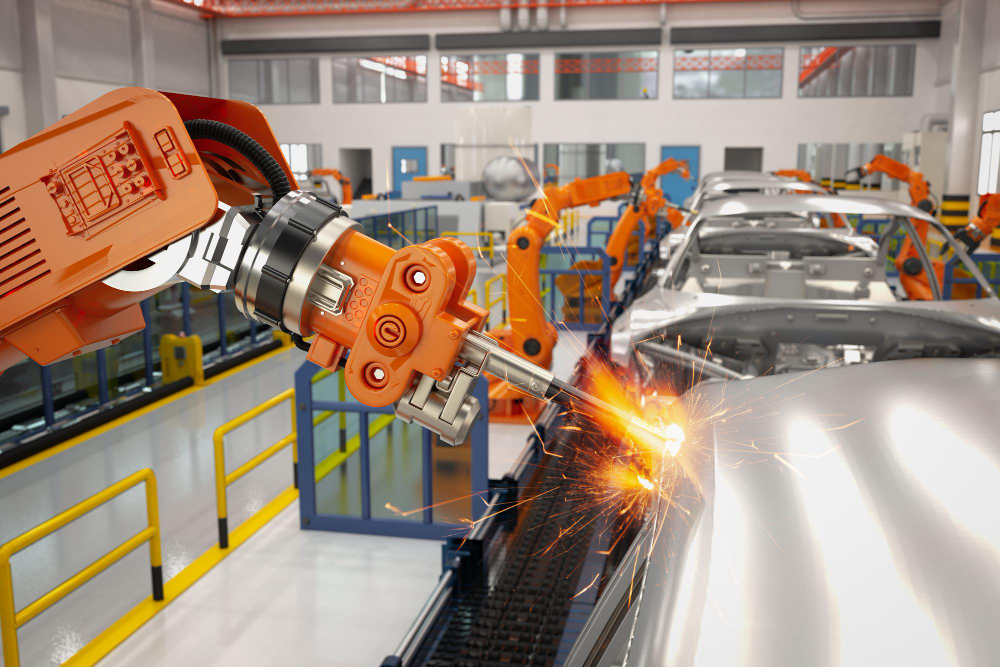
Class 4 is the highest hazard class. Class 4 lasers are hazardous from direct beam exposure, specular reflections, and diffuse reflections. They can cause skin burns and ignite materials, posing a fire hazard in addition to the optical radiation hazard. Industrial cutting, welding, and medical surgical lasers typically fall into this class. Comprehensive engineering controls, administrative controls, and personal protective equipment are all required.
Does a Class 5 Laser Exist?
No class 5 laser exists in any recognized international or national laser safety standard. The classification systems defined in both IEC 60825-1 and ANSI Z136.1 go up to class 4. There is no class 5.
References to class 5 lasers in online content, informal discussions, or fictional contexts are either errors, fabrications, or references to proprietary internal systems that have no basis in any recognized safety standard. If you encounter a product or document claiming class 5 classification, it does not correspond to any real regulatory framework, and the claim should be treated with caution.
How Classification Drives System Design
A laser’s classification has direct implications for the engineering controls, labeling, documentation, and safety infrastructure required for the product or system. Higher-class lasers require more extensive beam enclosures, more prominent warning labels, more comprehensive safety interlocks, and more rigorous operator training.
For OEM integrators and system designers, the laser classification determines what beam control and interlock components are needed. A class 4 laser system with optical power in the hundreds of watts requires a high-power laser shutter rated for that power level, with fail-safe closure, independent position sensing, and the service life needed to support the system’s intended operational lifetime.
Beam Control Matched to Your Laser Class
NM Laser Products offers safety laser shutters and optical shutters covering class 3B and class 4 applications, with optical power handling from 1 watt to 300 watts, apertures up to 20 millimeters, and LIDT ratings up to 15 J/cm².
Fail-safe, USA-manufactured, and backed by 35 years of engineering experience, our products are specified for the hazard level you are working with, not just the nearest standard size. Contact our team to discuss the right solution for your laser class and application.
FAQs
How many laser classes are there in the current classification system?
The current IEC 60825-1 and ANSI Z136.1 standards define seven laser classes: 1, 1M, 2, 2M, 3R, 3B, and 4. There is no class 5 laser in any recognized standard.
What is the main difference between class 3B and class 4 lasers?
Class 3B lasers are hazardous from direct and specular beam viewing, but diffuse reflections are generally not hazardous. Class 4 lasers are hazardous from all exposure pathways including diffuse reflections, and can also cause skin burns and ignite materials. Class 4 requires the most comprehensive safety controls of any laser class.
Can a product’s laser class change depending on how it is used?
A product’s laser classification is based on accessible emission during normal use as defined by the manufacturer. Modifying the product, defeating its enclosure, or using it outside its intended operating conditions can expose users to emission levels that exceed the product’s stated class, increasing the effective hazard level regardless of what the label states.
Related Blogs
Understanding OD (Optical Density) In Laser Safety Protocols
Quick Summary Optical density ratings determine whether a piece of...
Read more
Understanding Long-Pulsed Nd:YAG Laser Technology
Quick Summary Pulse duration significantly influences how a laser ...
Read more
Nd:YAG Lasers Explained: How They Work And Their Practical Uses
Quick Summary This type of laser combines a neodymium-doped crysta...
Read more