The Truth About Laser Beam Security Systems
Quick Summary
Laser beam security systems are widely misunderstood, largely because of how they are portrayed in popular media. This page looks at how these systems actually work, what their core components are, where they are genuinely used across industrial and commercial environments, and what their real limitations are. It also covers how beam control technology connects to laser safety in facilities where both security and high-power laser equipment are present.
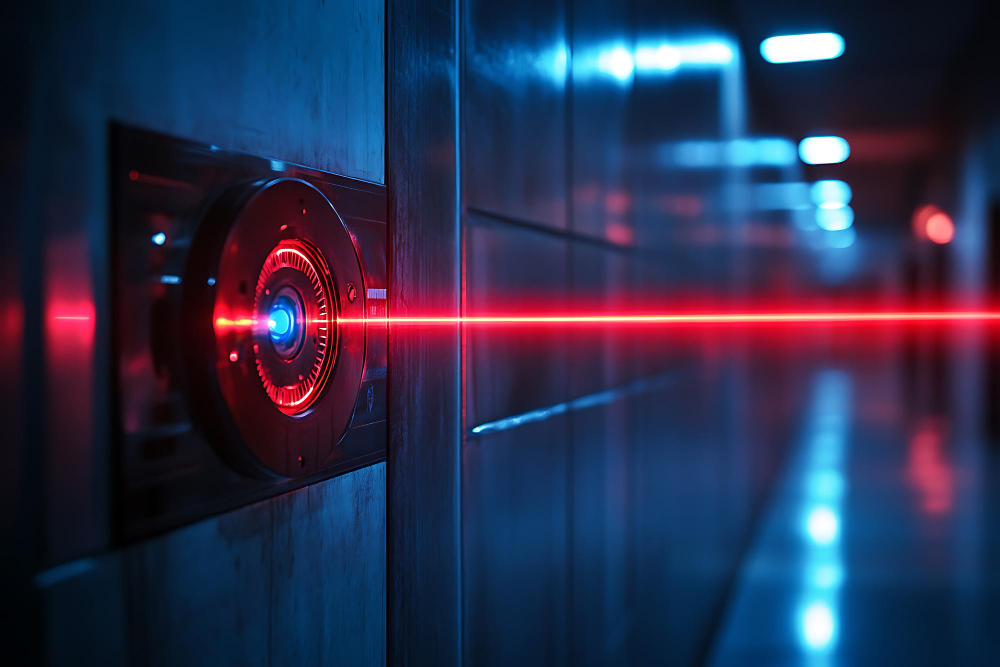
Popular culture has given most people a very specific mental image of a laser beam security system: a grid of glowing red lines filling a darkened room, with an agile intruder rolling and contorting to avoid them. The reality is both more practical and more interesting.
A real laser beam security system uses invisible wavelengths, intelligent signal processing, and precisely controlled beam delivery to protect spaces ranging from museum galleries to semiconductor fabrication plants, and it does so far more reliably than any movie prop would suggest.
What Is a Laser Beam Security System?
A laser beam security system works by projecting a laser beam across a defined space toward a receiver or reflector. When the beam path is interrupted, the receiver detects the change in signal and triggers an alarm or automated response. The concept is straightforward, but the engineering behind a reliable, low-false-alarm system is considerably more involved.
Modern security laser systems use near-infrared wavelengths, typically between 780 and 980 nanometers, which are invisible to the naked eye. The transmitter and receiver are carefully aligned, and the system continuously monitors the received signal for interruptions. Signal processing filters are applied to reduce false alarms from environmental factors like insects, airborne dust, or blowing vegetation, so that the system responds to genuine intrusions rather than background noise.
Core Components of a Security Laser System
A functional security laser system consists of several components working together. The laser transmitter emits the beam, typically using a low-power, eye-safe laser diode. The receiver detects the incoming beam and monitors it continuously for signal loss. In retro-reflective configurations, a mirror-like reflector bounces the beam back to a combined transmitter-receiver unit. In through-beam configurations, the transmitter and receiver are mounted on opposite sides of the protected zone.
The control unit processes the receiver signal, applies filtering logic, and triggers the appropriate response when a genuine interruption is detected. In installations that also include high-power laser shutter systems for manufacturing equipment, beam control and security functions can overlap, with safety shutters providing personnel protection across both domains.
Real-World Laser Beam Uses in Security
The range of laser beam uses in real security applications is broader than most people realize.
Perimeter protection is one of the most common applications. Long-range laser beam detectors can cover distances of several hundred meters, making them practical for securing the outer boundaries of warehouses, data centers, airports, and industrial facilities.
Indoor zone control uses laser beam detection to define restricted areas within buildings. In semiconductor cleanrooms, for example, unauthorized access to specific production areas can be automatically detected and logged without disrupting the controlled environment.
Asset protection in museums and galleries uses invisible laser detection grids around high-value exhibits. Because the beams are not visible, they protect without affecting the visitor experience or drawing attention to the protected objects.
Machine safety perimeters in industrial environments use laser beam systems to create protected zones around automated equipment. When a person enters the zone, the beam interruption triggers a machine stop before contact can occur, reducing injury risk in automated production settings.
What Laser Beam Security Systems Cannot Do
It is worth being direct about the limitations of this technology, because overestimating its capability leads to poorly designed security systems.
Standard laser beam detectors can be defeated by a patient attacker who knows the beam path and moves slowly enough to avoid triggering a signal change. Modern systems address this with multiple beams, randomized pulse coding, and overlapping coverage zones, but no single security technology is impenetrable on its own.
Environmental conditions affect performance significantly. Heavy fog, dense rain, and airborne dust can attenuate the laser beam and reduce detection reliability. Outdoor systems need to be specified and positioned with local environmental conditions in mind.
Alignment is also a maintenance consideration. Even small shifts in the mounting positions of the transmitter or receiver, caused by thermal expansion, vibration, or physical disturbance, can reduce signal strength and increase false alarm rates over time. Regular calibration is part of maintaining a reliable system.
Laser Beam Security in Industrial Laser Facilities
Facilities that operate high-power laser equipment for manufacturing face a security challenge that goes beyond standard perimeter protection. In these environments, the laser beam itself is a hazard, and controlling who can access the beam path is as important as controlling who can access the building.
In these settings, safety laser shutters serve a security function as well as a safety function. A safety interlock shutter that closes automatically when an enclosure is opened or an access door is breached physically blocks the laser beam from reaching an unprotected person, providing a level of protection that a detection system alone cannot deliver. The position sensors on these shutters confirm that the beam is actually blocked, rather than simply that the close command has been sent.
Reliable Beam Control for Laser Safety Applications
NM Laser Products manufactures safety laser shutters and optical shutters for facilities where beam control is a safety requirement, not just a performance consideration. Our shutters are fail-safe, USA-manufactured, rated for up to 300 watts of optical power, and built for service lives of up to 2 billion cycles.
With independent position sensors, factory-calibrated controllers, and over 35 years of engineering experience behind every product, we supply beam control hardware that industrial safety programs can depend on. Contact our team to discuss your application.
FAQs
What wavelength do laser beam security systems use?
Most modern security laser systems operate in the near-infrared range, typically between 780 and 980 nanometers. This makes the beam invisible to the naked eye while remaining reliably detectable by the system’s photoelectric receiver.
How far can a laser beam security system cover?
Detection range varies by system design and environmental conditions. Short-range indoor units typically cover 10 to 30 meters, while long-range outdoor systems can reach 200 meters or more with appropriate optics and receiver sensitivity.
Can mirrors be used to defeat a laser beam security system?
Modern security laser systems use coded, pulsed signals that a simple mirror cannot replicate. Reflecting the beam with a hand-held mirror would not satisfy the receiver’s authentication requirements, making this type of defeat significantly more difficult than popular media suggests.
Related Blogs
Understanding OD (Optical Density) In Laser Safety Protocols
Quick Summary Optical density ratings determine whether a piece of...
Read more
Understanding Long-Pulsed Nd:YAG Laser Technology
Quick Summary Pulse duration significantly influences how a laser ...
Read more
Nd:YAG Lasers Explained: How They Work And Their Practical Uses
Quick Summary This type of laser combines a neodymium-doped crysta...
Read more