Insights On Laser Shutter Controllers: What To Know
Quick Summary
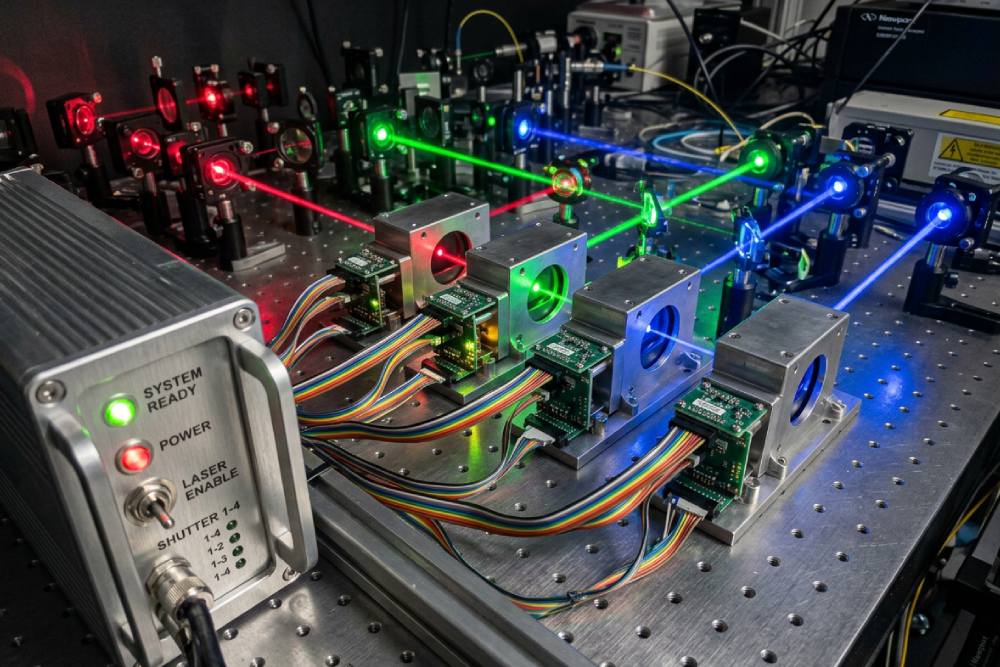
A laser shutter controller does more than simply open and close a shutter. It shapes the electrical waveform that determines how fast the shutter moves, how reliably it holds position, and how cleanly it closes. This page covers what a controller actually does, why the drive waveform matters so much to shutter performance, how laser interlock shutters work within safety systems, and what engineers should look for when selecting a controller for OEM or production use.
In most laser systems, the laser source gets the lion’s share of engineering attention. The beam control hardware, including the laser shutter controller, tends to be treated as a secondary consideration, something to sort out once the laser itself is specified.
This ordering of priorities is understandable but often leads to problems. A poorly matched or inadequately designed controller can prevent even a high-quality laser shutter from performing within specification, producing slower switching speeds, inconsistent open positions, premature wear, or outright failure to operate.
Understanding what a controller actually does, and what to look for when selecting one, saves significant integration headaches later.
What Does a Laser Shutter Controller Do?
A laser shutter is a mechanical device. It has an electromagnet, a flexure blade, and optics, and it requires a precisely shaped electrical current waveform to produce the correct mechanical response. The controller provides that waveform.
The challenge is that the optimal waveform for a given shutter is not a simple on-off signal. A square wave of fixed voltage applied to a shutter winding will produce a basic open-close response, but it will not extract the shutter’s best performance. Opening will be slower than possible, the hold current may overheat the winding over time, and closure may involve mechanical bounce that produces beam transmission artifacts at the end of each exposure.
A well-designed laser shutter controller delivers a multi-stage waveform that is calibrated to the specific shutter model being driven. The waveform typically includes an initial high-current boost to open the shutter quickly, a reduced and regulated hold current to maintain the open position without overheating, a controlled delay before closure, and a braking pulse that dampens the closing movement to prevent bounce. Each of these parameters needs to be calibrated to the inductance, winding resistance, and mechanical characteristics of the specific shutter being driven.
Opening Speed and the Boost Stage
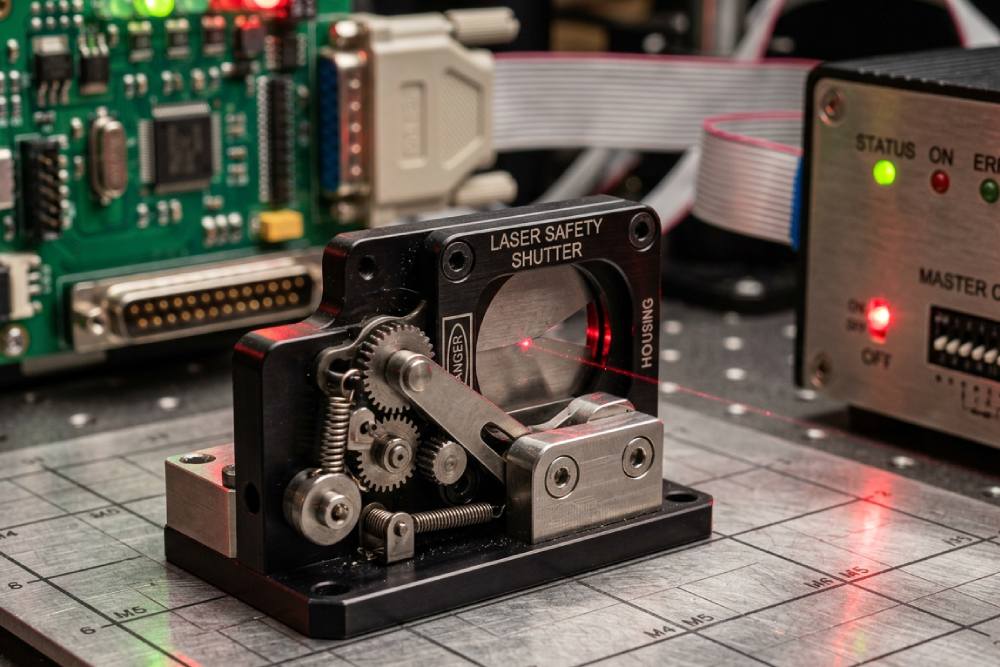
The opening speed of a laser shutter is determined primarily by the magnitude and duration of the initial current boost. A higher boost current accelerates the flexure blade faster, reducing the time from command signal to full beam clearance. However, this boost current cannot be sustained indefinitely because it would overheat the electromagnet winding. The controller transitions from boost to hold current within a precisely timed window.
Getting this timing right requires knowledge of the shutter’s electrical and mechanical characteristics. A boost that is too short leaves the shutter only partially open when it transitions to hold current. A boost that is too long wastes power and generates unnecessary heat. The CX4000B controller from NM Laser Products is factory-programmed with the correct boost timing for each specific shutter model it is paired with, removing this variable from the integrator’s workload.
Hold Current Regulation
Once the shutter is open, maintaining position requires a steady current through the electromagnet. Too much current generates heat that degrades the shutter winding over time. Too little may allow the shutter to drift, produce vibration in the blade, or fail to hold position reliably under mechanical disturbance.
The laser shutter driver regulates hold current precisely and adjusts it to compensate for changes in winding resistance as operating temperature varies. This temperature compensation is particularly important in production environments where the shutter operates continuously and the electromagnet temperature rises significantly above ambient during operation.
Closing Speed and Braking
When the shutter closes, the electromagnetic force is removed and the flexure blade returns to its blocked position under its own spring force. In some shutters, this closure can involve mechanical ringing, where the blade overshoots slightly and oscillates before settling. This ringing produces a brief period of partial beam transmission at the end of the shutter’s open phase, which is problematic for pulse gating and precision exposure control applications.
A controller with an active braking function applies a reverse current pulse during closure to dampen this oscillation, producing a clean, well-defined beam termination. The timing and magnitude of the braking pulse must be calibrated to the specific shutter and, for larger aperture shutters, to the gravity orientation of the installation.
Laser Interlock Shutters and Safety Systems
A laser interlock shutter is a specific type of safety shutter designed to close automatically when a safety condition is violated. Common triggers include an enclosure being opened, an emergency stop being activated, or a beam path being unintentionally cleared of its target. The shutter closes physically, blocking the beam, rather than simply removing power from the laser, which may have a finite shutdown delay.
Safety laser shutters used in interlock applications are fail-safe by design. They close when power is removed, without requiring an active signal to maintain closure. This is a fundamental distinction from process shutters, which may hold their last commanded state during a power interruption. In a safety interlock application, the shutter must close on power loss to guarantee personnel protection.
The position sensors on interlock shutters provide an additional layer of verification. Rather than simply confirming that the close command was sent, the sensors physically audit the position of the flexure blade and report open or closed state to the safety control system. This distinction matters in safety-critical applications where confirmation of actual blade position, not just command state, is required.
Shutter Table Laser Machine Integration
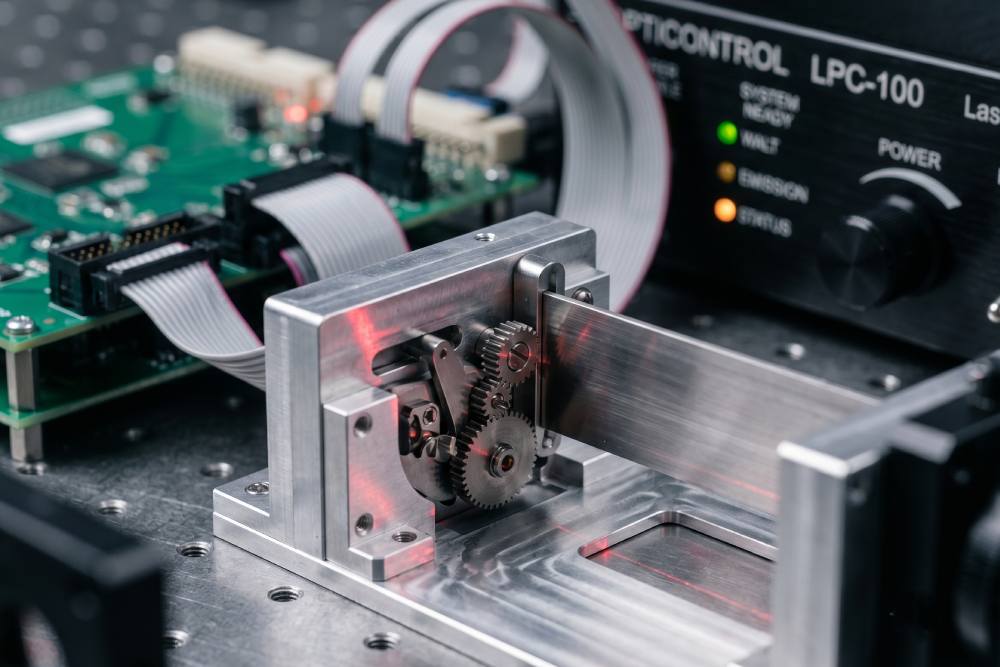
In a shutter table laser machine, the laser processes multiple zones or parts in sequence. The shutter opens to expose each zone, closes while the table moves to the next position, and opens again for the next exposure. The controller must sequence this open-close cycling reliably at the repetition rate demanded by the production throughput target.
Timing accuracy is important here. If the shutter opens before the table has fully settled at the new position, the beam strikes the wrong location. If it closes too slowly at the end of an exposure, the beam edge quality suffers. Programmable timing parameters in the controller allow engineers to fine-tune the sequence for each application, optimizing for throughput while maintaining process accuracy.
Matched, Calibrated, Ready to Integrate
At NM Laser Products, the CX4000B laser shutter controller is factory-calibrated to each specific shutter model before shipping. It delivers optimized waveforms, regulated hold current, active close damping, opto-isolated control inputs, and reverse polarity protection, all in a PCB-level package that accepts control signals from 3 to 24 VDC. Backed by 35 years of USA manufacturing and engineering, it is the fastest path from shutter to working system. Contact our team to discuss your integration requirements.
FAQs
Can I build my own laser shutter drive circuit instead of using a dedicated controller?
User-built circuits are possible and are used in some research settings. However, achieving the precise multi-stage waveform needed for optimal shutter performance requires detailed knowledge of the shutter’s electrical and mechanical characteristics. A factory-calibrated controller eliminates this complexity and delivers proven performance from day one.
How does a laser interlock shutter differ from a standard process shutter?
A laser interlock shutter is fail-safe and closes automatically when power is removed, making it suitable for safety-critical applications where beam blockage must be guaranteed on power loss. A standard process shutter may hold its last commanded position during a power interruption and is used for beam control in processing or modulation applications rather than personnel protection.
What happens if the controller and shutter model are mismatched?
A mismatched controller can result in the shutter opening too slowly, failing to reach the fully open position, overheating the winding, or producing mechanical bounce on closure. In worst cases it can cause permanent damage to the shutter. Always use a controller that has been matched and calibrated to your specific shutter model.
Related Blogs

Understanding OD (Optical Density) In Laser Safety Protocols
Quick Summary Optical density ratings determine whether a piece of...
Read more
Understanding Long-Pulsed Nd:YAG Laser Technology
Quick Summary Pulse duration significantly influences how a laser ...
Read more
Nd:YAG Lasers Explained: How They Work And Their Practical Uses
Quick Summary This type of laser combines a neodymium-doped crysta...
Read more