UV Laser Vs. Fiber Laser: What Makes Them Different

Conversations about precision marking and industrial applications sometimes steer toward a debate about UV laser vs. fiber laser. Both represent powerful innovations in photonics, yet their differences shape how they interact with different materials.
UV lasers specialize in fine, low-heat processing. Fiber lasers excel in deep, fast, and durable marking on metals and hard surfaces. Recognizing how each works reveals why engineers and manufacturers choose one over the other depending on the project’s goals.
The Basics of UV and Fiber Lasers
A UV laser generates light at a very short wavelength, typically around 355 nanometers. This results from frequency-tripling the base wavelength of a solid-state laser.
The shorter wavelength carries less thermal energy but delivers high photon intensity, making it suitable for cold marking. Cold marking minimizes heat-affected zones and prevents damage to surrounding areas.
In contrast, fiber lasers emit light at longer wavelengths, usually around 1064 nanometers. These lasers rely on optical fibers doped with rare-earth elements like ytterbium. The design brings high power output and stable operation during long duty cycles. Fiber lasers are ideal for metals and hard polymers due to their effective energy interaction with these surfaces.
Both technologies manipulate light but differ in wavelengths and energy absorption, which define their operational limits. Understanding these differences sheds light on the UV laser vs. fiber laser debate.
Applications That Define Each Laser’s Purpose
UV lasers are often used in applications that require precision without damaging the substrate. They can mark plastics, glass, and silicon wafers with sharp clarity. Electronics manufacturers rely on them for delicate circuit markings. Medical device producers use them for fine text and traceability on sensitive materials. The ability to perform cold processing is what makes the UV laser valuable in sectors where accuracy and cleanliness matter.
Fiber lasers occupy a different niche. Their high-power density and efficiency make them indispensable for cutting, welding, engraving, and deep marking of metals. Automotive and aerospace industries use them for serial numbers, barcodes, and component labeling.
They can also cut through reflective materials like aluminum or copper, which absorb infrared wavelengths effectively. The result is a reliable, permanent mark capable of withstanding mechanical stress or exposure to harsh conditions.
Wavelength Influence and Material Interaction
Wavelength determines how a laser interacts with matter. The shorter wavelength of a UV laser penetrates the surface minimally but disrupts molecular bonds directly through photon energy. This mechanism allows for crisp lines and smooth textures on sensitive materials. It reduces the risk of melting or burning, which can distort fine features.
Fiber lasers, by comparison, generate more heat during operation. Their energy penetrates deeper into the material – suitable for high-speed engraving and cutting. The trade-off is that this heat can sometimes alter the surrounding material’s color or texture.
Still, in many cases, that is desirable since it contributes to strong, durable marks.
The Importance of Laser Shutters in System Performance
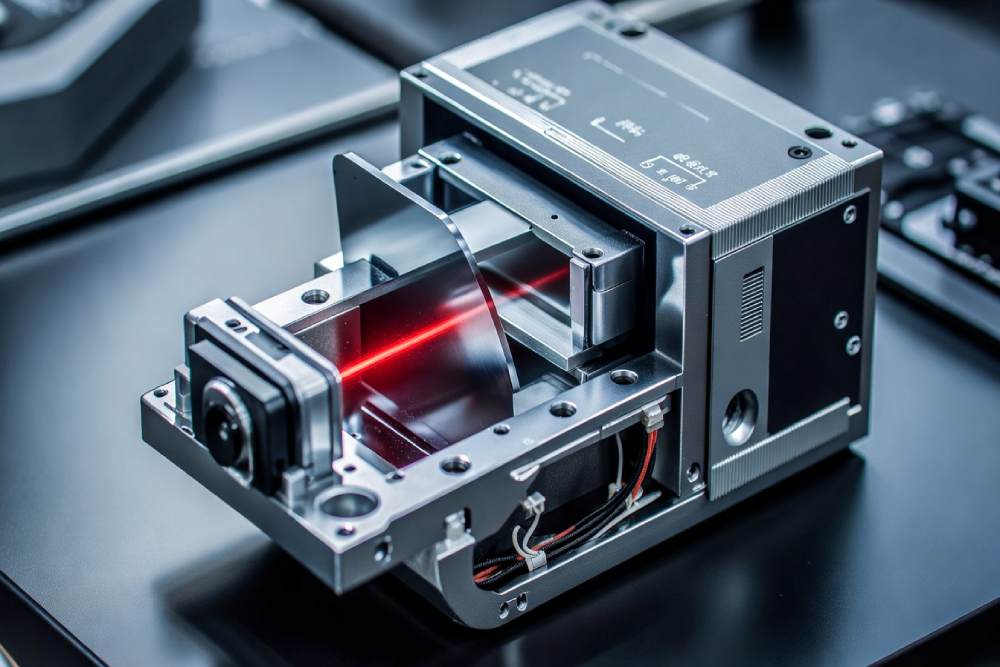
The performance of either laser depends not only on the beam itself but also on how precisely it can be controlled. Laser shutters and optical beam shutters matter greatly in this control system. These components regulate the exposure time of the laser beam by acting as optical gates that open or close within microseconds.
In UV systems, UV laser shutters are engineered to handle shorter wavelengths and higher photon energy without degrading over time. Their coatings and materials must maintain optical stability across countless cycles of use.
The speed and accuracy of these shutters define how cleanly each pulse is delivered, which is particularly important for micro-texturing or micro-engraving tasks.
Fiber laser systems also depend on precise shutter operation. Their higher power output requires shutters capable of handling intense energy levels without optical distortion. The consistency of laser shutters guarantees uniform beam modulation, which will lead to dependable performance during extended production runs.
This control capability reflects the sophistication of laser shutter technology, where mechanical precision and optical design meet. Every pulse must occur within a tightly defined time frame, and every exposure window must be perfectly in keeping with the material’s response characteristics.
Without this synchronization, even advanced laser systems could lose their precision edge.
Comparing Efficiency and Maintenance
Fiber lasers are generally more efficient in terms of electrical-to-optical conversion. Their design allows them to operate with minimal maintenance, and they can run continuously for long periods.
This efficiency translates to lower operational costs, especially in high-volume manufacturing environments. Their durability makes them a preferred choice for applications where uptime and consistency are imperative.
UV lasers, while usually lower in energy output, offer a different kind of efficiency. They minimize rework or waste because they do not damage delicate materials. The cost per unit may be higher, but the precision justifies it in industries where fine tolerances are mandatory.
Maintenance involves protecting optical components from contamination and providing for alignment accuracy. The shutters used in UV systems must also retain their integrity to maintain pulse accuracy over time.
Advancements in Laser Technology
Innovation continues to refine both types of lasers. Fiber lasers have benefited from improved beam quality and compact power supplies that increase their adaptability. Manufacturers now use them for engraving, cleaning, and surface structuring.
UV lasers have also progressed, featuring faster repetition rates and more consistent beam profiles. This advancement supports even smaller and more detailed markings on miniaturized parts.
The supporting components, including laser shutters and optical beam shutters, change alongside these systems. High-speed actuators, new optical coatings, and refined laser shuttle technology contribute to consistent beam control. These developments push performance boundaries, so engineers can apply both laser types across broader industrial and scientific applications.
The Value of Expertise in Precision Engineering
The decision between UV and fiber lasers depends on the nature of the work. A UV laser’s short wavelength and cold processing capability favor fine detail on sensitive materials. A fiber laser’s high power and longer wavelength favor depth and durability on metals and hard composites. Each has strengths defined by physics and refined by engineering.
At NM Laser Products, precision in optical control is our specialty. Our team focuses on designing laser shutters that line up with the operational needs of UV, fiber, and other advanced systems.
Contact NM Laser Products to discuss how our technology can support your laser system or research application.
Related Blogs
Class 4 Laser Safety Shutters: What You Need To Know
High-power laser systems operate in a space where precision and ris...
Read more
Choosing A High-Power Laser Shutter For Pulsed Applications
Selecting a high-power laser shutter for pulsed applications requir...
Read more
High-Energy Pulsed Laser Shutters: Uses And Benefits
Modern laser systems operate at energy levels where timing mistakes...
Read more