Erbium YAG Laser Vs. CO2 Laser: Which Is Better?
Quick Summary
Erbium YAG lasers target water in the skin more aggressively than CO2 lasers, producing shallower ablation with a shorter recovery window, while CO2 systems reach deeper and add more thermal coagulation for tighter, longer-lasting results. Neodymium YAG lasers operate at a different wavelength entirely and serve separate applications, including laser YAG capsulotomy, hair removal, and vascular treatment.
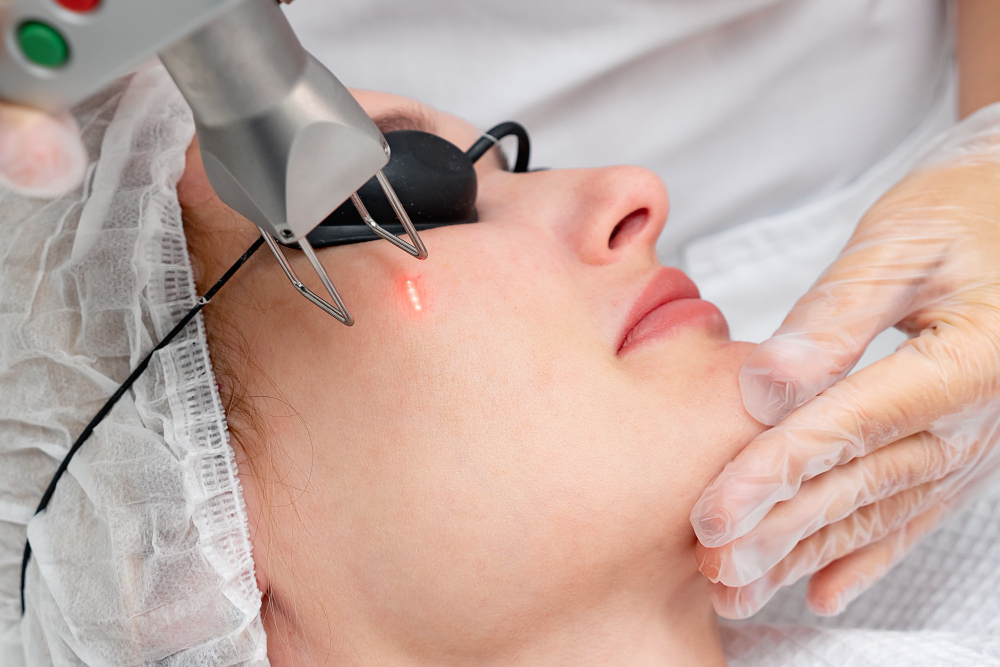
Picking between an Erbium YAG laser vs. CO2 system for skin resurfacing depends on how deep the treatment needs to reach and how much downtime the patient can accept afterward. Both wavelengths ablate tissue, but they interact with water in the skin at different rates, which changes everything from healing time to the number of sessions a treatment plan calls for.
Manufacturers building either platform rely on YAG-rated shutter systems to control beam exposure with the same precision the procedure itself demands.
What Separates Erbium YAG from CO2 in Skin Resurfacing
An Erbium YAG laser operates at 2,940 nm, a wavelength that water absorbs far more strongly than the 10,600 nm wavelength used by CO2 systems. This means the Erbium beam removes tissue in thinner layers with less heat spreading into the surrounding skin, which shortens recovery time and lowers the chance of prolonged redness.
CO2 lasers, by contrast, generate more thermal effect alongside the ablation, which triggers a stronger collagen response and often produces more dramatic tightening for deeper wrinkles or significant scarring, at the cost of a longer healing period. The right choice often depends on how much downtime a patient can accept against how much correction the treatment needs to deliver.
Where Neodymium YAG Laser Fits into the Picture
A Neodymium YAG laser runs at 1,064 nm, a wavelength with almost nothing in common with Erbium YAG beyond sharing the same host crystal. Instead of shallow surface ablation, Nd:YAG light penetrates deep into tissue, which makes it a common choice for hair removal, vascular lesion treatment, tattoo removal, and select surgical procedures.
Equipment builders working across this range often standardize on a multi-wavelength shutter model capable of handling several YAG harmonics, since a single platform may need to switch between 1,064 nm and its frequency-doubled or tripled outputs depending on the procedure.
Understanding Laser YAG Capsulotomy
Laser YAG capsulotomy is a common ophthalmic procedure that uses a Neodymium YAG laser to open a cloudy capsule that sometimes forms behind an intraocular lens after cataract surgery. The procedure has nothing to do with skin treatment, but it shares the same underlying laser technology as some Nd:YAG dermatology platforms, which is why equipment manufacturers sometimes build across both markets using a common shutter and driver architecture.
The short, precise pulses required for capsulotomy demand the same tight beam control that skin and surgical applications rely on, just tuned to a very different treatment target.
Equipment Considerations Across CO2 and YAG Wavelengths
Building a system around any of these wavelengths starts with beam control components rated for the specific optics in use. A CO2 laser shutter needs gold or specialized coatings suited to the 10,600 nm range, while YAG platforms depend on dielectric mirrors tuned to 1,064 nm or its harmonics.
Mixing up the optics for a given wavelength shortens component life and can introduce damage to the shutter itself, which is why manufacturers typically spec shutters by wavelength rather than assuming one coating works everywhere.
Choosing the Right Wavelength for Your Application
There is no single answer to which laser performs best, since Erbium YAG, CO2, and Neodymium YAG each serve a different purpose.
Skin resurfacing programs weigh downtime against results, ophthalmic and vascular applications look to Nd:YAG for its penetration depth, and equipment builders across all three often need a custom shutter design that matches their specific pulse pattern and power range rather than a generic off-the-shelf part.
Wavelength-Specific Shutter Solutions from NM Laser Products
At NM Laser Products, we build the shutters and controllers that support Erbium YAG, CO2, and Neodymium YAG laser platforms across medical and industrial applications. Our team has spent over 35 years developing high-power, high-reliability shutter technology, and every unit we manufacture is made in the USA to hold up under demanding clinical and production schedules.
If your system calls for a standard model or a fully custom design built around a specific wavelength or pulse pattern, we work directly with your engineering team to match the shutter to the application. Our components are built for long service life, often rated for hundreds of millions of cycles, keeping output consistent across every procedure or process run.
Reach out to our team to talk through your project, or submit your specs through our online RFQ page to get a shutter built around your exact requirements.
FAQs
Is Erbium YAG laser vs. CO2 mainly a question of downtime?
Downtime is one major factor, though the two also differ in how much thermal tightening they produce, with CO2 generally delivering stronger collagen response at the cost of longer recovery.
How does a Neodymium YAG laser differ from an Erbium YAG laser?
Neodymium YAG operates at 1,064 nm and penetrates deep into tissue, while Erbium YAG works at 2,940 nm and stays close to the surface, making the two suited to very different procedures.
What is laser YAG capsulotomy used for?
It is an ophthalmic procedure that uses a Neodymium YAG laser to clear a cloudy capsule behind an intraocular lens following cataract surgery, restoring clear vision without additional incisions.
Related Blogs
Why You Should Consider An LCD Optical Shutter
Quick Summary Liquid crystal shutters block and transmit light thr...
Read more
Why Choose A CO2 Laser Shutter Manufacturer For Your Business Needs
Quick Summary Selecting a manufacturer for CO2 laser shutter compo...
Read more
Why Adjusting The Diagonal On Your CO2 Laser Machine Matters
Quick Summary How well a CO2 laser machine's beam tracks acro...
Read more