Essential Class 3R (IIIa) Laser Safety Information
Quick Summary
Class 3R lasers present greater risks than their relatively modest power output might suggest. Optical density ratings play a critical role in determining which safety products can effectively prevent hazardous beam exposure from reaching the eyes.
Selecting the right shutter or filter requires a close match between optical density, wavelength, and laser power. A general assumption that a laser is safe because it has “low power” can leave significant gaps in protection.
What is OD laser safety? Why does it matter for anyone working around a Class 3R (IIIa) laser? Optical density, or OD, measures how effectively a material attenuates laser light at a particular wavelength.
For visible-light Class 3R systems, output power ranges from 1 to 5 milliwatts. That places these lasers just above the fully eye-safe threshold associated with Class 2 devices. Although the difference in power may appear small, it changes the safety considerations considerably.
A direct Class 3R beam or a specular reflection can still cause retinal injury, especially when exposure lasts for an extended period or occurs repeatedly. Laboratories, manufacturing floors, and research facilities using these lasers need practical protective measures in place. Treating a Class 3R designation as automatically low risk can create unnecessary exposure hazards.
Understanding Class 3R (IIIa) Lasers
The Class 3R designation occupies a middle position within the laser safety classification system. These lasers produce more energy than Class 1 or Class 2 devices but remain below the output levels associated with Class 3B and Class 4 systems.
Alignment lasers, certain laboratory instruments, and various measurement tools can fall within this classification. Because their output sits relatively close to the eye-safe limit, operators may sometimes handle Class 3R equipment with less caution than the application requires. That mindset can increase exposure risks when a beam crosses walkways, workstations, or areas shared with other equipment.
Regulatory bodies classify lasers according to factors such as output power, wavelength, and exposure conditions. Classification itself, however, does not physically prevent someone from encountering the beam.
Physical barriers, beam enclosures, and shutter mechanisms create the physical controls that help protect personnel during normal operation, alignment, servicing, and maintenance.
What Is OD Laser Safety? Breaking Down Optical Density
Optical density describes the attenuation produced by a protective material at a specific wavelength. The value uses a logarithmic scale. For example, an OD 4 rating reduces transmitted light by a factor of 10,000.
The appropriate OD rating depends on the laser’s wavelength, power, and the potential exposure duration if the beam reaches unprotected eyes or skin. This is one area where laser safety decisions can become confusing. A filter or shutter with a high OD rating at one wavelength may deliver little or inadequate attenuation at another wavelength.
Laser safety documentation therefore specifies OD ratings across particular wavelength ranges. Matching the protective device to the exact laser being used is essential. Relying on a general OD value or guessing based on the product name can leave personnel exposed to hazardous radiation.
Why Class 3R Lasers Still Demand Real Protection
Some facilities underestimate Class 3R systems because these lasers sit toward the lower end of the classification scale. Their relatively low output does not eliminate the possibility of injury. Extended exposure, reflections from metal or glass surfaces, and improperly aligned optical paths can all create genuine hazards.
Laser-related eye injuries may not cause immediate pain. A worker might not recognize that damage has occurred until symptoms develop later, making preventive controls especially important.
Reliable laser shutters and optical beam shutters mechanically interrupt the beam path. This creates a physical safeguard that does not rely entirely on a person’s reaction time or visual judgment.
A warning label or written procedure cannot physically stop a beam. A properly selected shutter can close the beam path when triggered through a manual switch, interlock system, or automated control loop.
Choosing the Right Laser Shutter for Class 3R Applications
Selecting a safety laser shutter for a Class 3R system means accounting for wavelength compatibility, response speed, and the physical footprint available in the optical setup.
Some facilities need a shutter that integrates directly into an existing beam path with minimal modification. Others require a unit built to withstand higher duty cycles in continuous research or production environments.
Response time matters more than most people expect. A shutter that closes in milliseconds offers meaningfully better protection than one built for slower industrial applications where speed is not a priority.
Laboratories running frequent alignment procedures, in particular, benefit from shutters designed for rapid, repeated cycling without degradation in performance over time.
Material construction influences longevity, too. Housings built from durable metals hold up under daily use far longer than lightweight alternatives. That difference shows up in maintenance costs over the life of the equipment.
Customization Matters for Laser Safety Systems
No two laser setups are identical, and standard off-the-shelf shutters do not always fit the physical or optical requirements of a given system.
A custom optical shutter can be built around specific mounting constraints, wavelength ranges, aperture sizes, or control interfaces already present in a facility’s equipment.
Custom builds also solve problems that generic products cannot, such as fitting a shutter into a compact optical bench or matching a legacy control system still running in an older laboratory setup.
Facilities working with specialized wavelengths, unusual beam geometries, or tight space constraints frequently find that a purpose-built shutter outperforms a generic model in both fit and function.
Ordering a custom solution also means the specifications are documented and verified for that exact application, rather than approximated from a general catalog listing.
Building a Safer Laser Environment
Laser safety involves more than selecting a single piece of equipment. Effective protection combines accurate classification, appropriate OD selection, physical beam control, and consistent operating procedures.
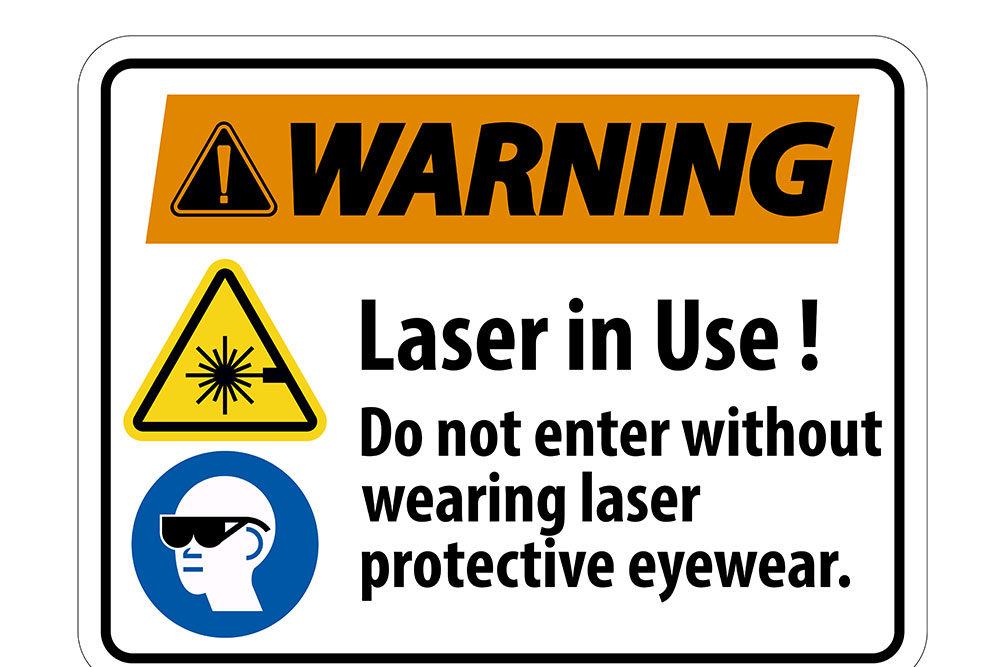
Facilities that treat Class 3R lasers with appropriate seriousness can reduce exposure risks despite the relatively modest power output of these systems. Training personnel on beam paths, displaying accurate laser safety signage, and regularly inspecting protective equipment all contribute to a safer working environment.
These practices do not replace the physical protection created by a properly designed shutter. Together, however, they create a layered safety approach that can address weaknesses that one safeguard alone might leave behind.
We built NM Laser Products around the principle that selecting laser safety equipment should not involve guesswork.
With more than 35 years of experience designing shutters and optical components, we have seen firsthand how much a properly specified and well-built product can affect performance and safety on a laboratory bench or production floor.
Every unit we manufacture is made in the USA. We hold our products to the same reliability standards we would expect if we were the people working next to the beam.
We also recognize that every facility has its own configuration. That is why we work directly with customers to develop shutters around their specific wavelength, response-speed, and mounting requirements instead of forcing a one-size-fits-all solution into a specialized application.
Working with a laser safety equipment supplier that has decades of hands-on experience can reduce installation surprises and eliminate unanswered questions about how a shutter will function during everyday operation. That experience is one reason facilities continue returning to us for project after project.
If you have any questions about NM Laser Products, our team is always glad to talk through your specific application. Contact us today.
Frequently Asked Questions
Do Class 3R lasers require operators to wear safety glasses at all times?
Not necessarily during every operation, but eyewear rated for the specific wavelength should be available and worn whenever the beam path is exposed or during alignment procedures. Facility safety officers typically define exact requirements based on the specific setup and exposure risk.
How do I know what OD rating my facility actually needs?
The correct OD rating depends on the laser’s wavelength, power output, and the maximum exposure duration a person could realistically experience. This calculation should reference the specific laser’s technical specifications rather than a general industry assumption.
Can existing laser systems be retrofitted with a shutter instead of replacing equipment?
In most cases, yes. Shutters can often be added to an existing optical path without replacing the entire laser system, particularly when the mounting and control interface details are shared with the manufacturer ahead of time.
Related Blogs
Understanding Long-Pulsed Nd:YAG Laser Technology
Quick Summary Pulse duration significantly influences how a laser ...
Read more
Nd:YAG Lasers Explained: How They Work And Their Practical Uses
Quick Summary This type of laser combines a neodymium-doped crysta...
Read more
An Overview Of Laser Welding Safety Practices
Quick Summary Laser welding introduces hazards that differ signifi...
Read more