How Does A CO2 Laser Work? A Detailed Breakdown
Carbon dioxide lasers are widely used across industrial, medical, and scientific fields due to their stable output and strong interaction with many materials. Answering the question “how does CO2 laser work” requires examining the interaction between gas molecules, electrical energy, and optical components inside the laser system.
Here are the operating principles that allow a CO2 laser to generate precise, high-energy infrared light for controlled material processing.
Fundamentals of CO2 Laser Technology
The work begins with recognizing it as a gas-based infrared laser system. Unlike solid-state lasers, it relies on energized gas molecules to generate light. This design, which is also present in custom laser shutters, supports stable output, high optical quality, and sustained operation across manufacturing, medical, and scientific environments worldwide today.
CO2 laser shutters emit light in the mid-infrared spectrum, typically around 10.6 micrometers. This wavelength interacts strongly with many non-metal materials and organic matter.
The laser system combines electrical power, controlled gas flow, optical alignment, and thermal management to transform electrical energy into a focused, coherent beam of light.
The Role of the Gas Mixture: CO2, Nitrogen, and Helium
Inside the laser tube, a carefully balanced mixture of carbon dioxide, nitrogen, and helium gases drives the light generation process. Nitrogen absorbs electrical energy first and transfers excitation efficiently to carbon dioxide molecules.
Carbon dioxide molecules produce the actual laser photons. On the other hand, helium stabilizes the system by removing excess heat and returning CO2 molecules to lower energy states. This interaction maintains steady output and extends operational life without excessive thermal stress on components.
Electrical Excitation and Energy Transfer Mechanisms
A high-voltage discharge passes through the gas mixture, exciting nitrogen molecules to higher vibrational states. Nitrogen then transfers this energy to carbon dioxide molecules through molecular collisions rather than light emission, which improves overall system performance during sustained operation.
Energy transfer from nitrogen to carbon dioxide happens through molecular collisions inside the tube. Carbon dioxide molecules absorb this transferred energy and move into excited vibrational modes. These excited states form the basis for photon emission once the molecules interact with existing infrared photons inside the resonator structure.
Stimulated Emission and Infrared Wavelength Generation
Stimulated emission occurs when an excited carbon dioxide molecule encounters a photon matching its energy difference. The molecule releases a second photon identical in wavelength, phase, and direction. This process amplifies light intensity rapidly and forms the coherent beam characteristic of laser systems across industrial and medical settings.
Photons are emitted at discrete infrared wavelengths, most commonly near 10.6 micrometers. Because infrared light is invisible, specialized optics and safety measures guide and monitor the beam during operation.
Understanding “How does CO2 laser work?” requires appreciating this precise interaction between molecules and photons.
The Laser Resonator: Mirrors and Optical Feedback
The resonator consists of two opposing mirrors placed at each end of the laser tube. One mirror reflects nearly all infrared light, while the other allows a small portion to pass through. This configuration traps photons, forcing repeated passes through the excited gas to amplify light intensity.
As photons bounce between mirrors, optical feedback builds until gain exceeds losses. Once this threshold is reached, a stable laser beam exits the partially transmissive mirror. Mirror quality and alignment influence beam shape, power stability, and overall performance during prolonged use.
Beam Formation, Focusing, and Power Density
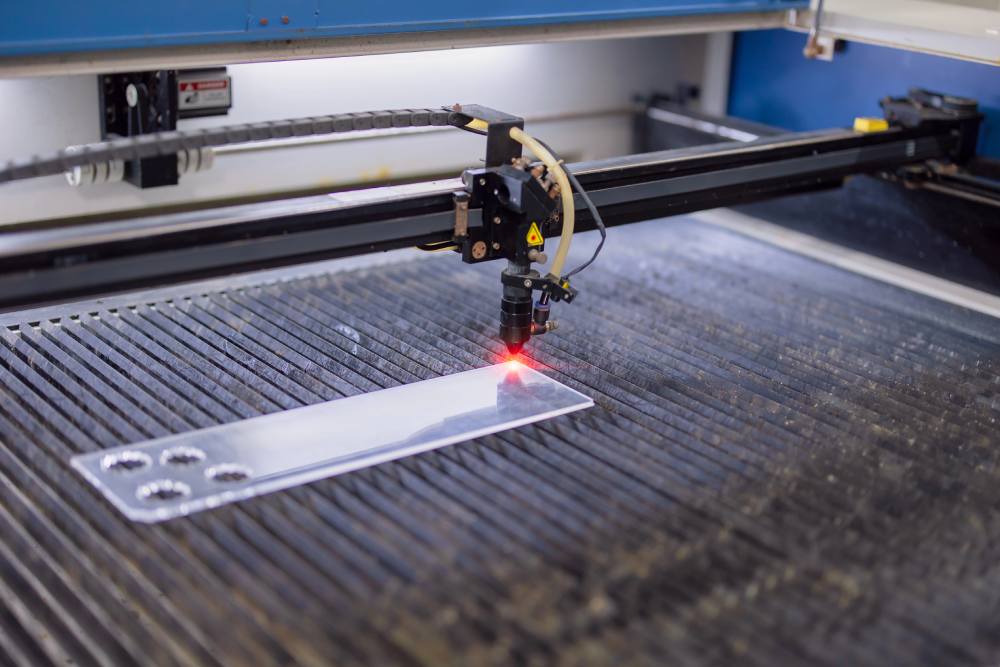
After leaving the resonator, the beam passes through mirrors and lenses that shape and direct it. Beam quality depends on optical alignment, lens condition, and system design. Proper focusing concentrates energy into a small spot and creates high power density at the target surface.
High power density allows rapid heating of materials. Energy absorption causes localized melting, vaporization, or ablation depending on material properties and exposure time. Adjusting focal length and beam diameter controls cut width, engraving depth, and thermal impact in the surrounding area.
Interaction of CO2 Laser Radiation with Materials
Infrared radiation from a CO2 laser is absorbed efficiently by materials containing water, organic compounds, or certain polymers. Absorption converts light energy into heat within the material structure. This localized heating drives cutting, engraving, marking, or surface modification without mechanical contact or tool wear.
Metals reflect much of the infrared wavelength, limiting direct cutting capability without assistance. High power levels, surface coatings, or oxygen-assisted processes improve absorption. Nonmetal materials such as wood, acrylic, rubber, and textiles absorb energy strongly, producing clean processing with precise thermal control.
Continuous Wave vs. Pulsed CO2 Laser Operation
Continuous wave operation delivers a constant output beam as long as electrical excitation continues. This mode suits cutting and welding tasks requiring steady energy delivery. Power levels remain stable, which supports smooth edges and predictable thermal behavior across long processing paths and repeated production cycles.
Pulsed operation releases energy in short bursts rather than a constant beam. Pulsing limits heat accumulation and improves control when working with thin materials or delicate surfaces. By adjusting pulse duration and frequency, operators manage material response while reducing charring, distortion, or unintended thermal spread.
Efficiency, Limitations, and Thermal Considerations
CO2 lasers convert a modest portion of electrical input into usable optical output. Much of the remaining energy becomes heat, requiring cooling systems to maintain stable operation. Water or air cooling removes excess thermal load, protecting optics, gas mixtures, and structural components from degradation over time.
System size, gas replenishment, and optical alignment represent practical limitations. Compared to fiber lasers, CO2 systems occupy more space and require additional maintenance.
Still, their wavelength advantages and material compatibility keep them relevant for applications where infrared absorption characteristics remain highly favorable.
Things to Remember with CO2 Laser Operation
A CO2 laser operates through controlled electrical excitation of a gas mixture, optical amplification within a resonator, and precise beam delivery to a target surface. Each component, from gas composition to focusing optics, contributes to stable infrared output and predictable material interaction.
Together, these principles explain why CO2 lasers remain a trusted solution across manufacturing, medical treatment, and research environments.
For expert guidance and reliable systems, contact us at NM Laser Products to discuss CO2 laser solutions suited to your application.
Related Blogs
Understanding OD (Optical Density) In Laser Safety Protocols
Quick Summary Optical density ratings determine whether a piece of...
Read more
Understanding Long-Pulsed Nd:YAG Laser Technology
Quick Summary Pulse duration significantly influences how a laser ...
Read more
Nd:YAG Lasers Explained: How They Work And Their Practical Uses
Quick Summary This type of laser combines a neodymium-doped crysta...
Read more